Note: the video and the text are the same review. There are additional observations below the text review that are not in the video.
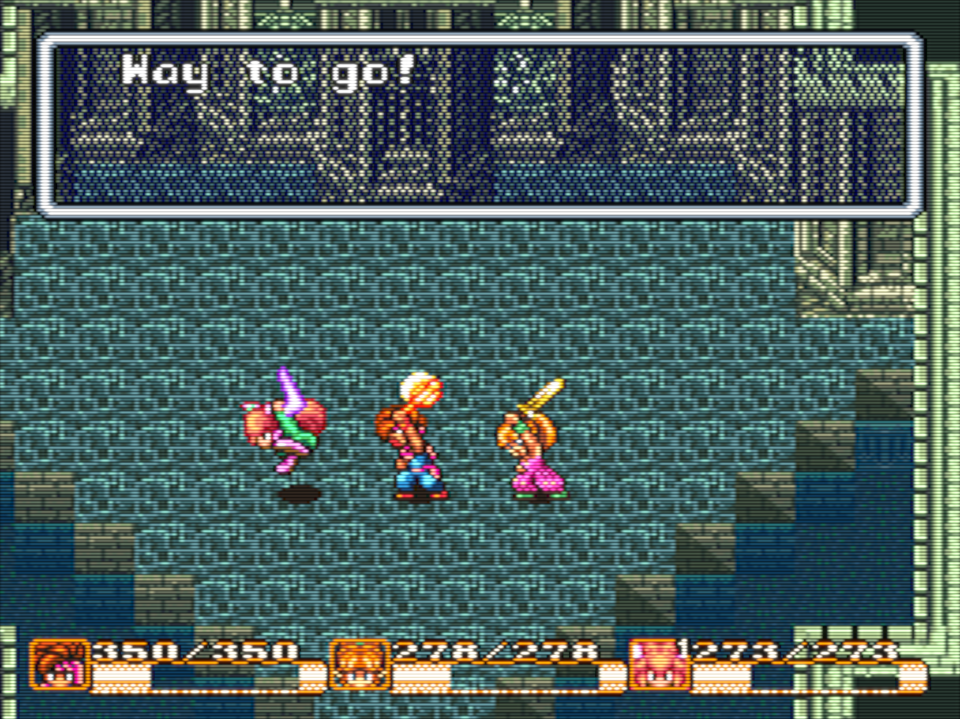
Secret of Mana is going thorough a re-evaluation. It has traditionally been considered one of the best JRPGs or action-adventures on the SNES, and sits near the top of many “Best of” lists.
Today, similar to the classic Sonic the Hedgehog games, people are playing Secret of Mana and coming away with some quizzical looks. “Is this it?”, they are saying. “What’s all the fuss about.”
I don’t think either Sonic or Secret of Mana are getting a fair assessment from these newer players, but as somebody who recently completed Secret of Mana, there were times I wanted to quit, too.
The combat is particularly unpalatable to those of us acclimatised to modern game design. Unlike most action games, you can rarely dodge enemy attacks, and are forced to take them on the chin. You regularly have control taken away from you as you recover from long stun conditions. When you attack, sometimes you hit the enemy, and sometimes you don’t, but it seems to be random, making the player feeling like they aren’t in control. Enemies can be spongy, and if hitting them again and again doesn’t wear on your patience, the pathfinding of your AI companions certainly will.
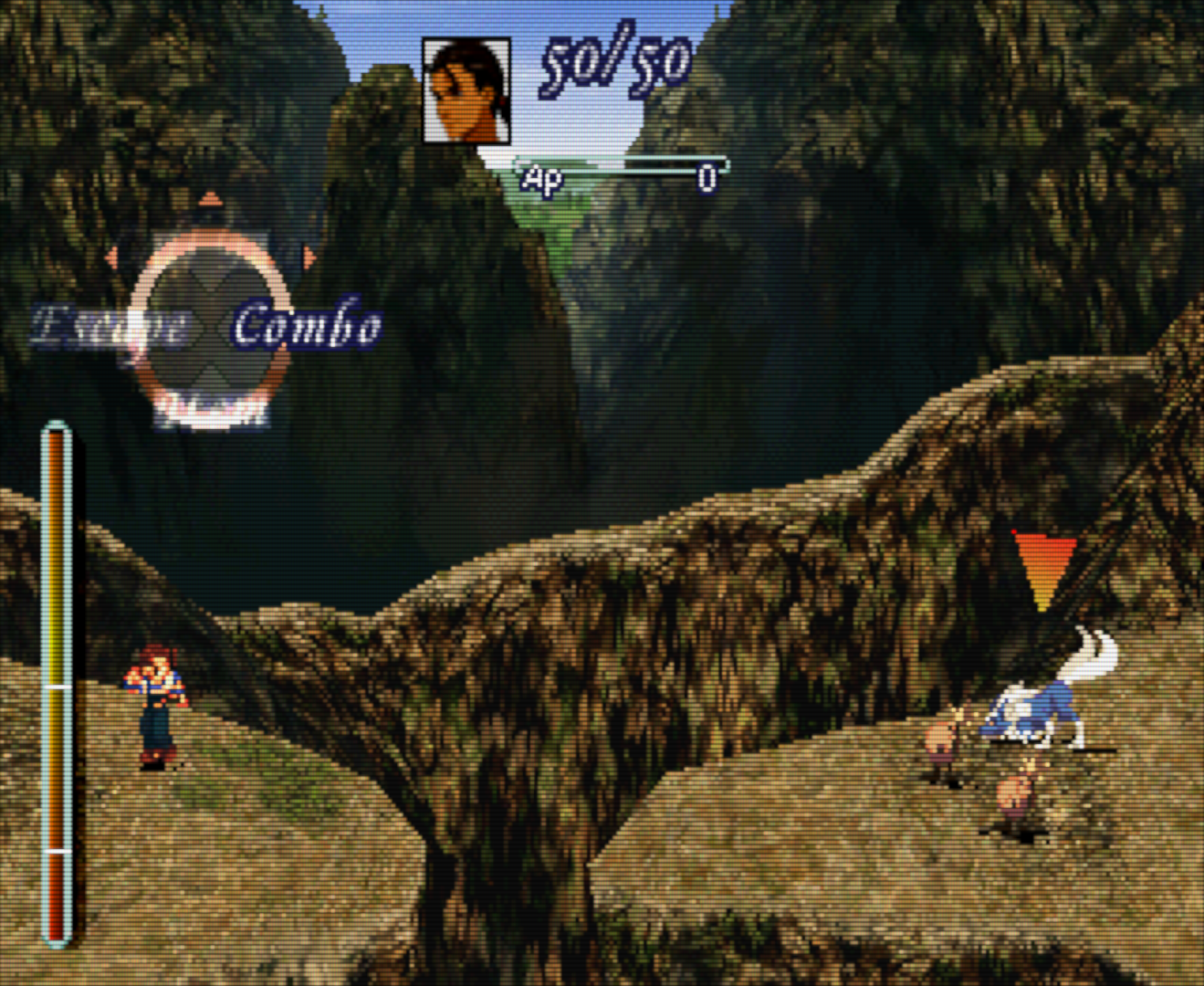
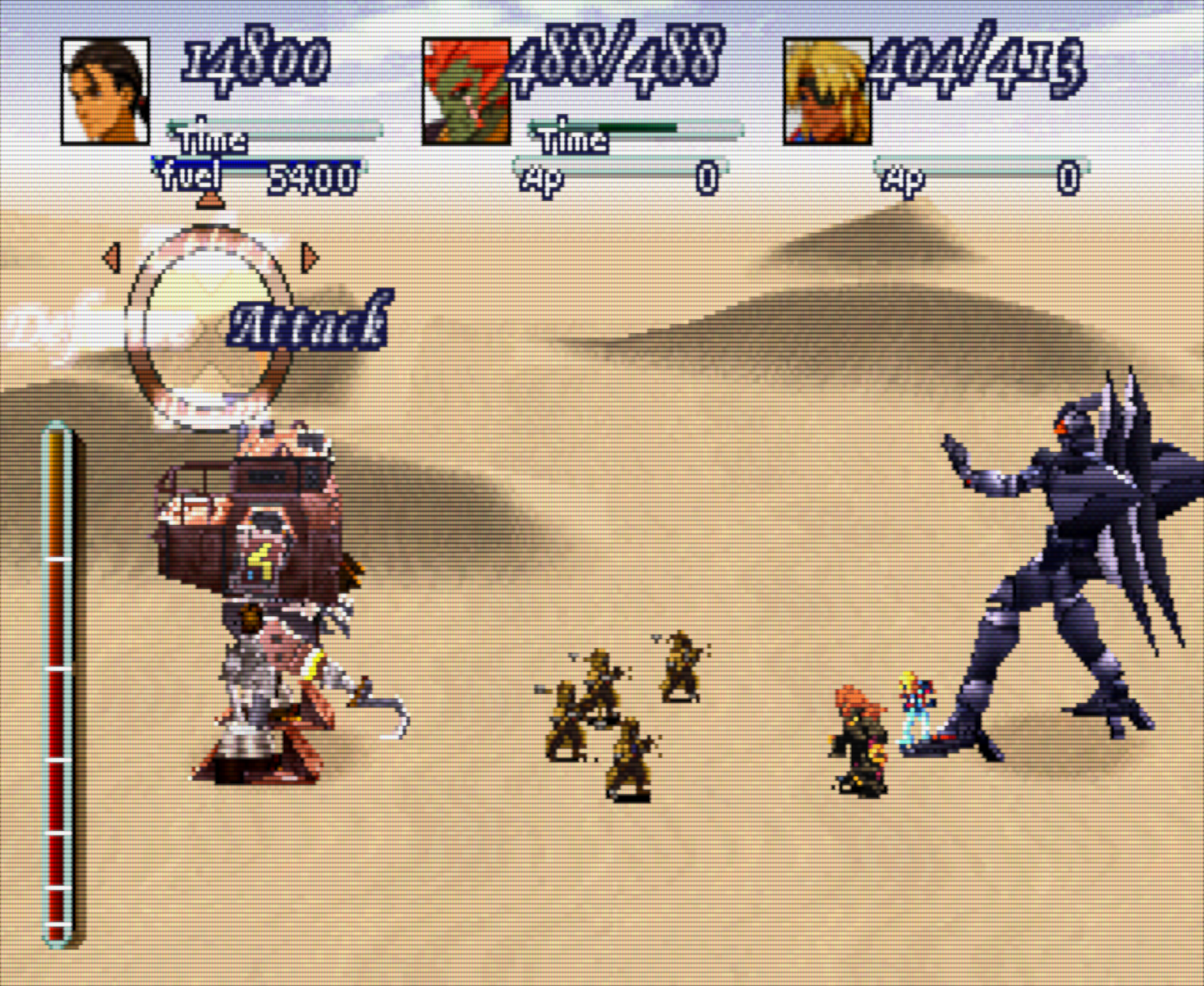
It seems like textbook “bad game design”, but I want to defend Secret of Mana. It comes back to something I said a moment ago, that Secret of Mana used to be considered a great action-adventure or JRPG. But which is it: an action-adventure or a JRPG? It certainly looks like Zelda and has action-game controls, but as you explore the mechanics you realise it has a lot of mechanical similarities to an ATB system like Final Fantasy IV. You have to wait between each attack for your attack gauge to fill up, and special attacks are chosen from a menu. Looks are deceiving here, but Secret of Mana isn’t really an action game.
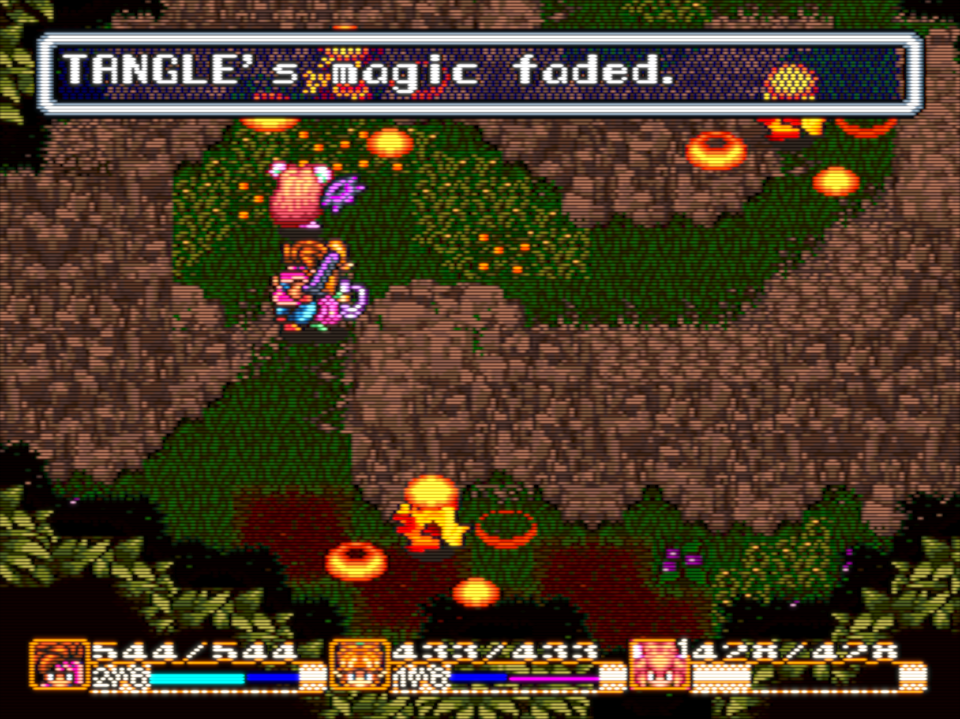
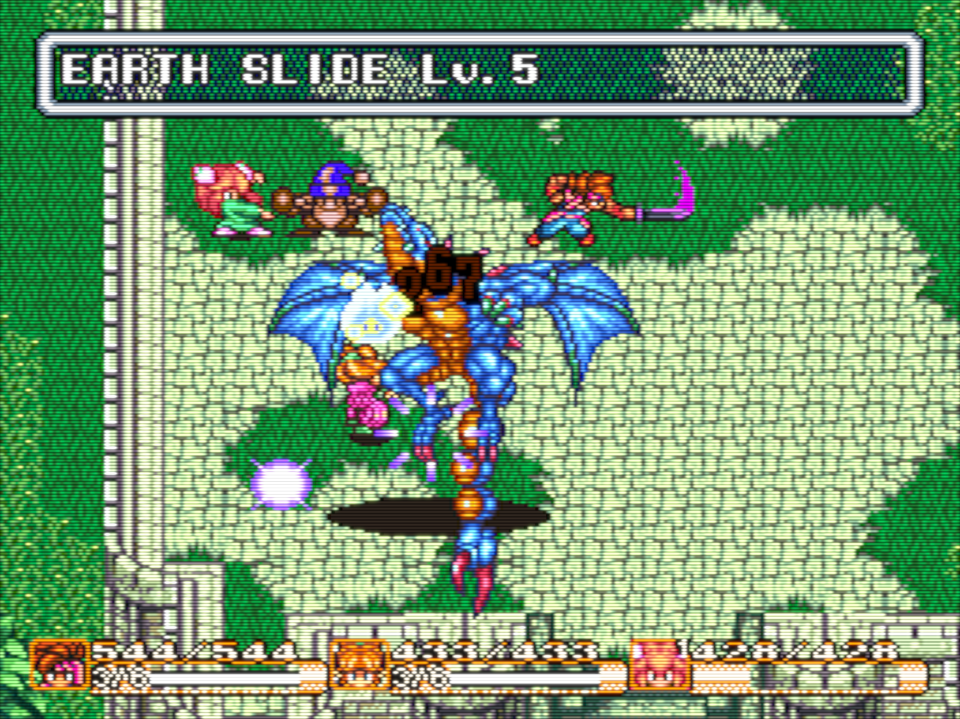
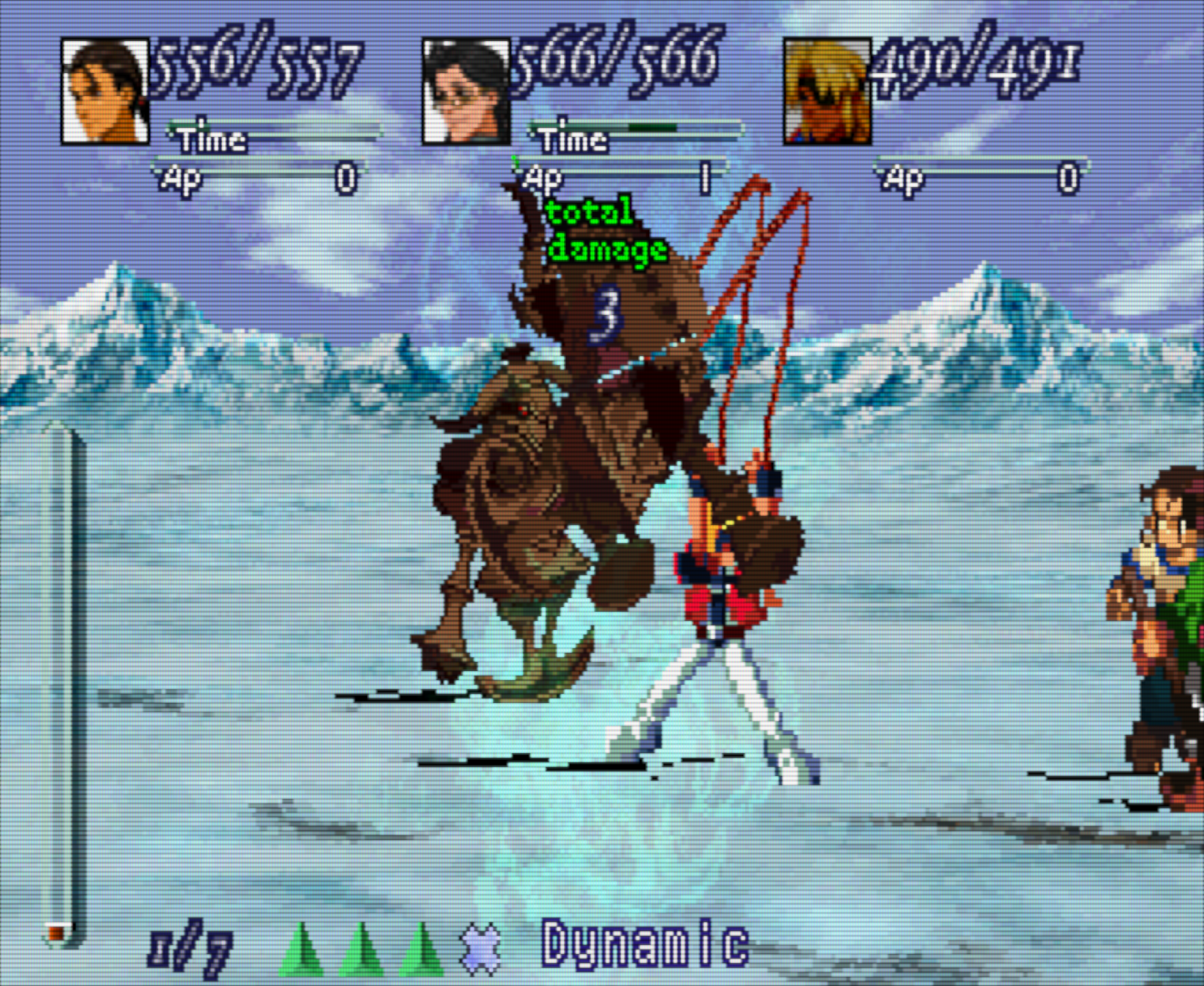
In JRPGs combat isn’t enjoyed for the fast-paced skill involved. Rather you enjoy them for some slower paced decision making and, most importantly, the spectacle. In Secret of Mana, When multiple spells are popping off in real-time across the screen — attacks, buffs, heals all at once, from enemies and party members at the same time — you start to see the appeal that Secret of Mana would have had in 1993: of seeing the spectacle of a JRPG battle from a top-down, real-time perspective.
Blowing up an enemy in one magic that hits a weakness never gets old, and though charge attacks take an age to reach full power when they hit, and the big numbers start flying, it’s totally worth it.
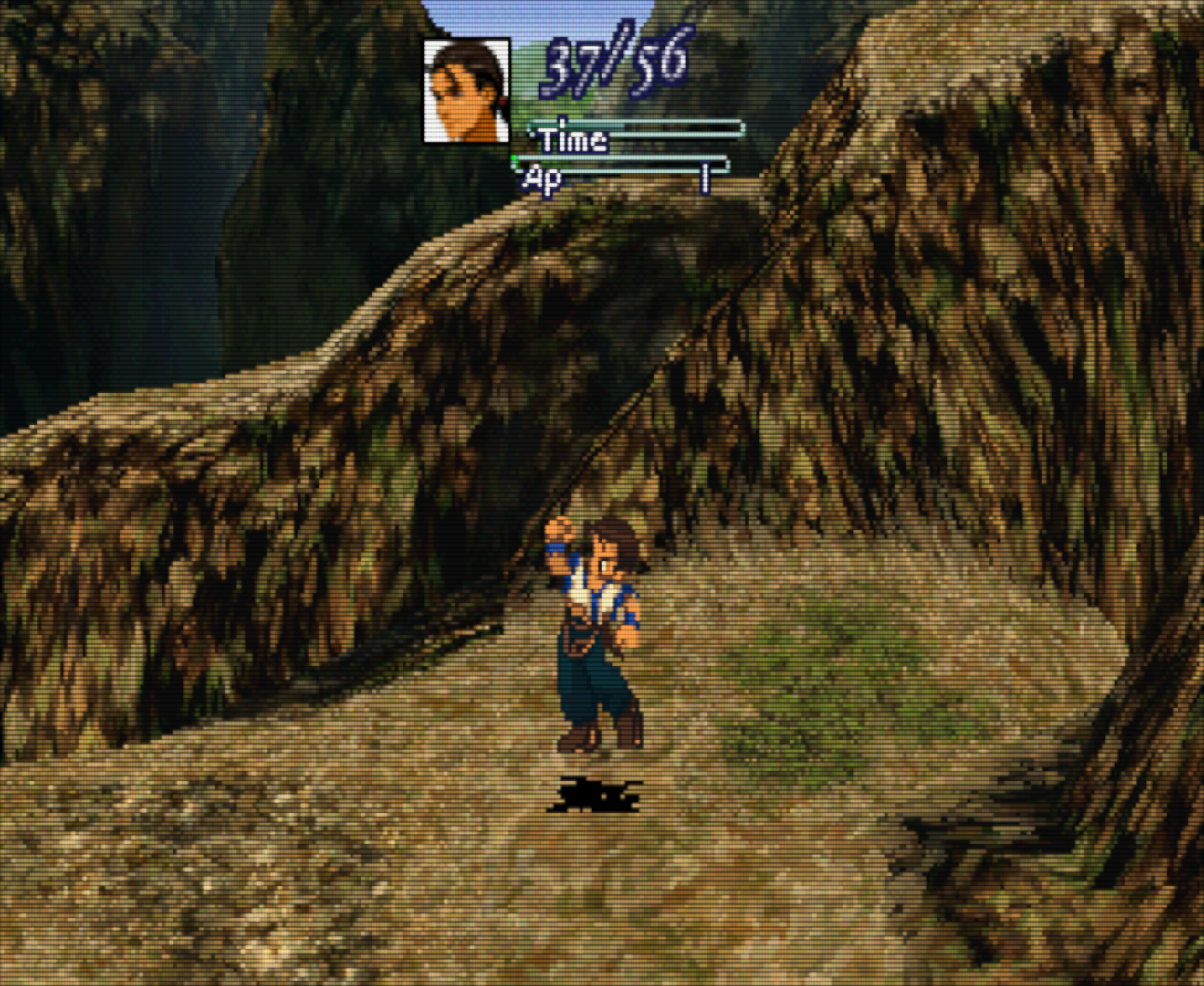
It is also worth it because each enemy you kill helps raise your weapon level, and this is where Secret of Mana starts to get a bit addictive.
It starts with weapon orbs, which are found in the world and they are extremely enticing because they allow you to transform your weapon at the blacksmith, which gives more damage, a new charge level, and usually some sort of secondary effect. But you don’t get the benefit of the new weapon until the character has used that weapon type enough. All characters can use all weapons, but they only gain proficiency with whichever ones you use for them, which encourages you to mix up which weapons you use while also creating a uniqueness to your party: in your game, the girl might be proficient with the axe and the bow, in another player’s game, the girl might be proficient with the fist and the whip.
(Your companions don’t have default names in the Western translation. I called the girl Tangle and the spite Brave).
It’s a similar story for magic spells. Spells are grouped by magical spirits as if they were spellbooks: the more you use that spirit’s spells, the more powerful that spirit and its spells become.
Remember that the first mana game was The Final Fantasy Legend, and I find it interesting to consider that in a different timeline, this second mana game might have been “The Final Fantasy Legend 2”, and Udine might have been Shiva, Djinn might have been Ifrit, and so on. That’s just theoretical, but what isn’t theoretical is how these systems make it really rewarding to keep fighting enemies, even when the combat feels a little janky.
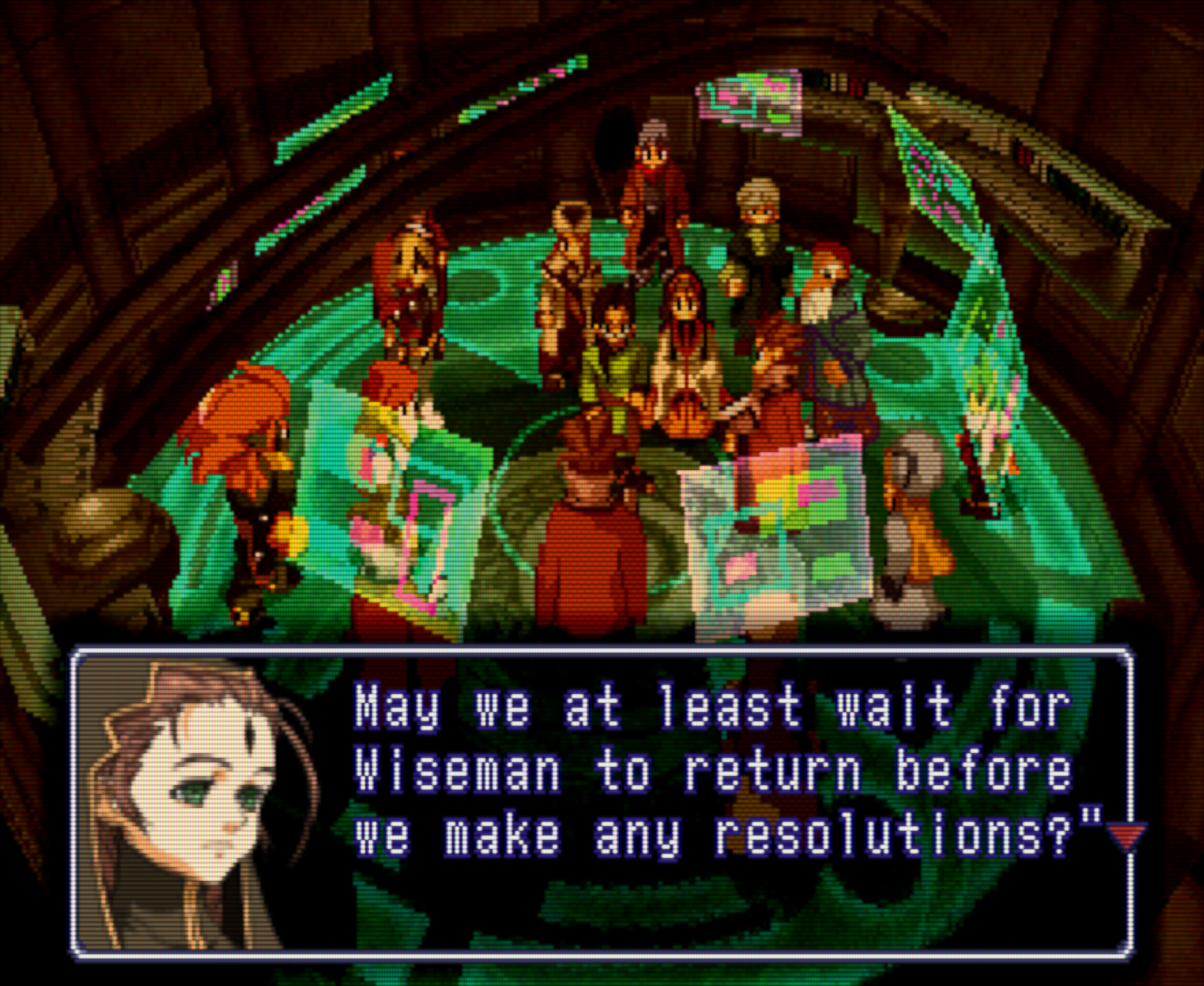
Now we’re talking about Final Fantasy, we have to point out that while action adventure games might get away without, JRPGs require a strong story, but Secret of Mana doesn’t have that. It has a handful of characters with a thimbleful of development each. It really lacks the complexity you expect from Square Enix.
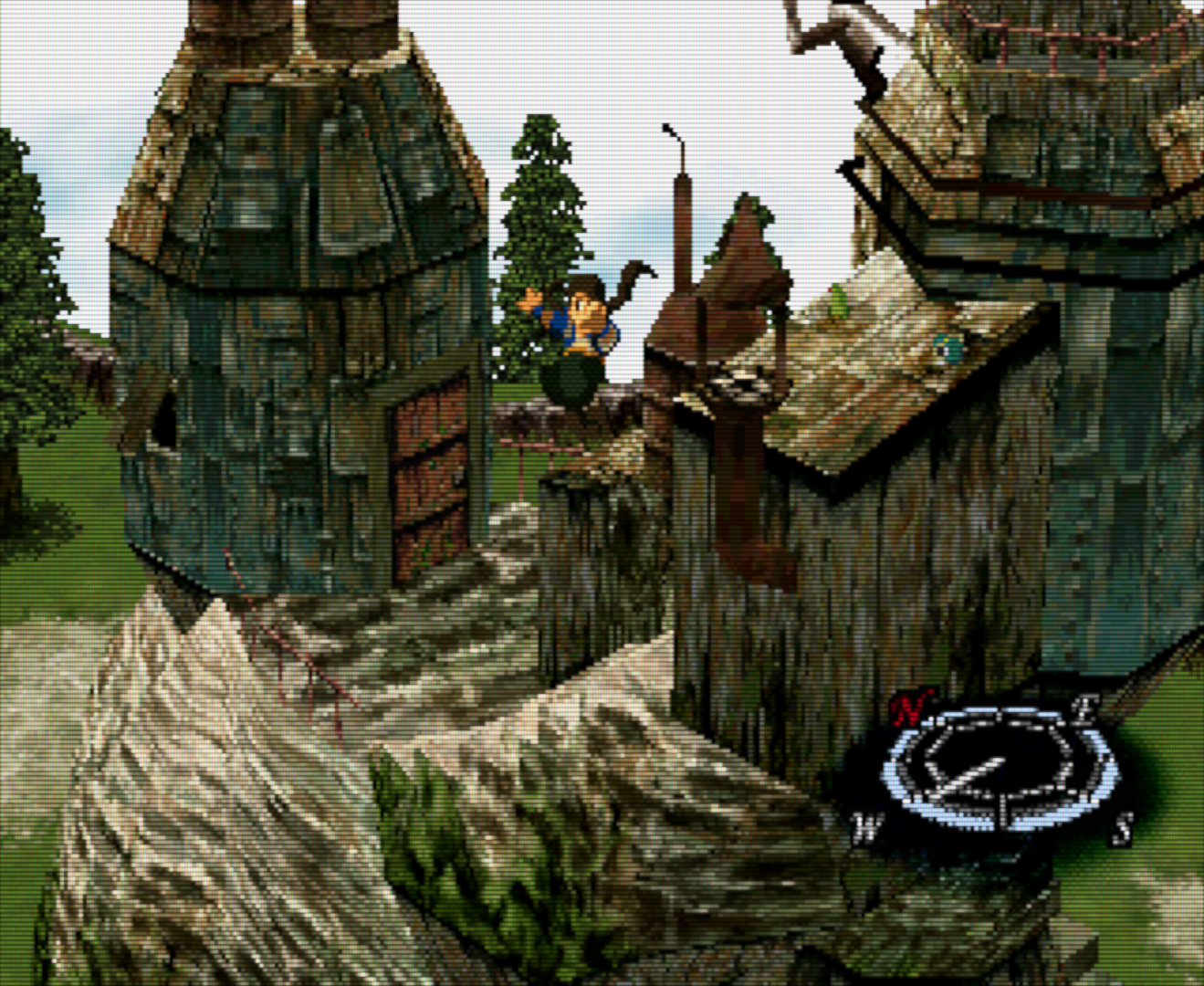
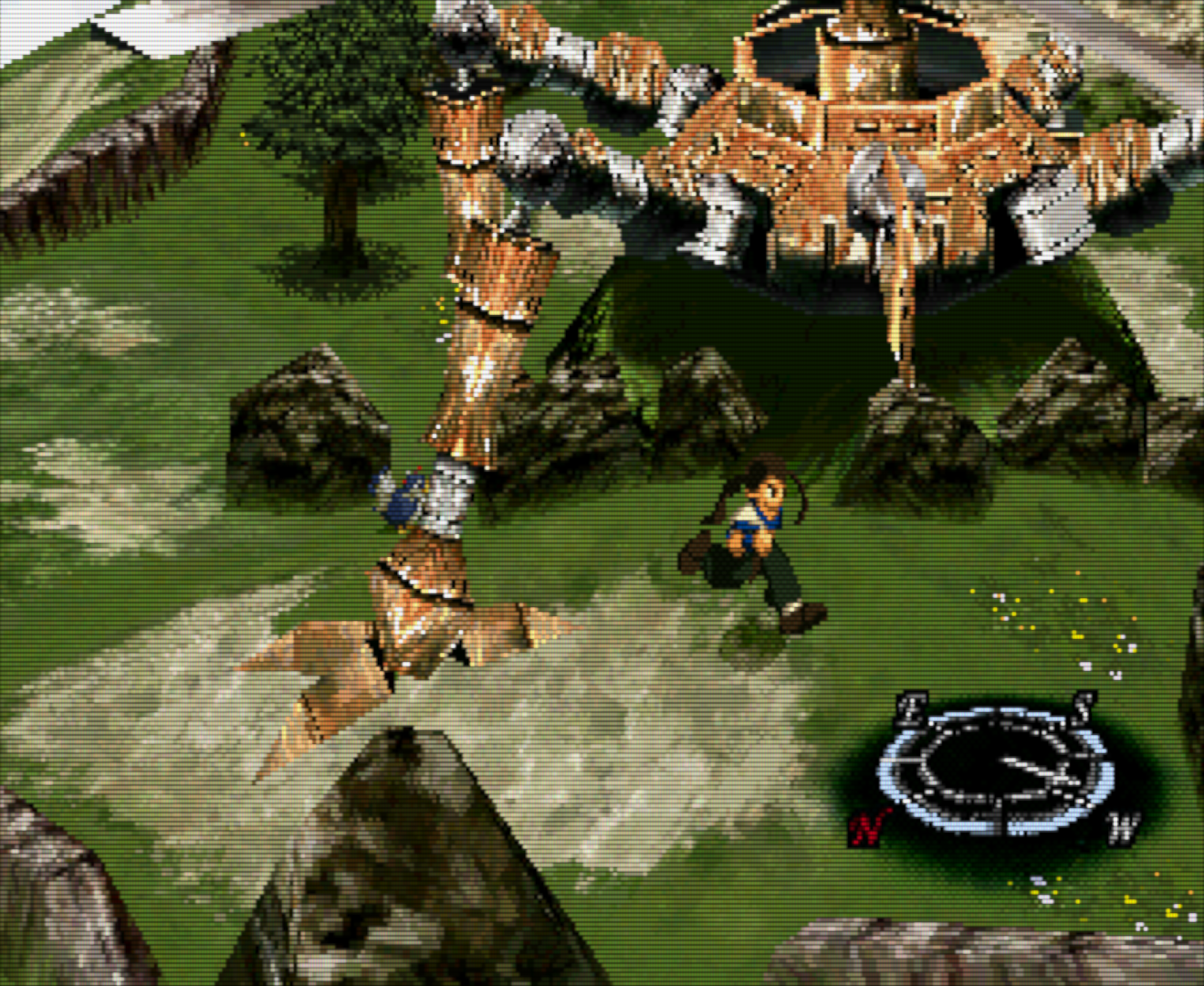
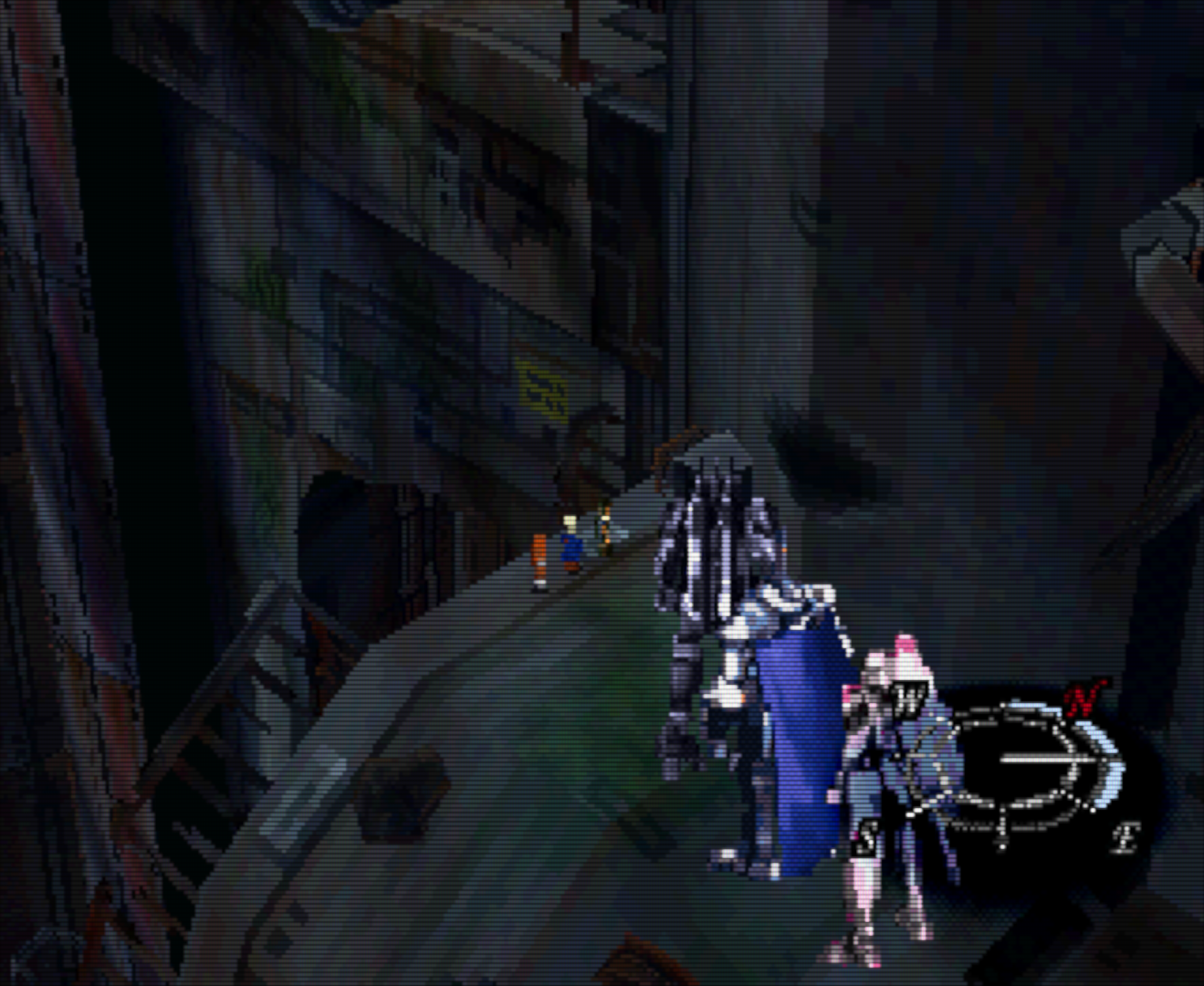
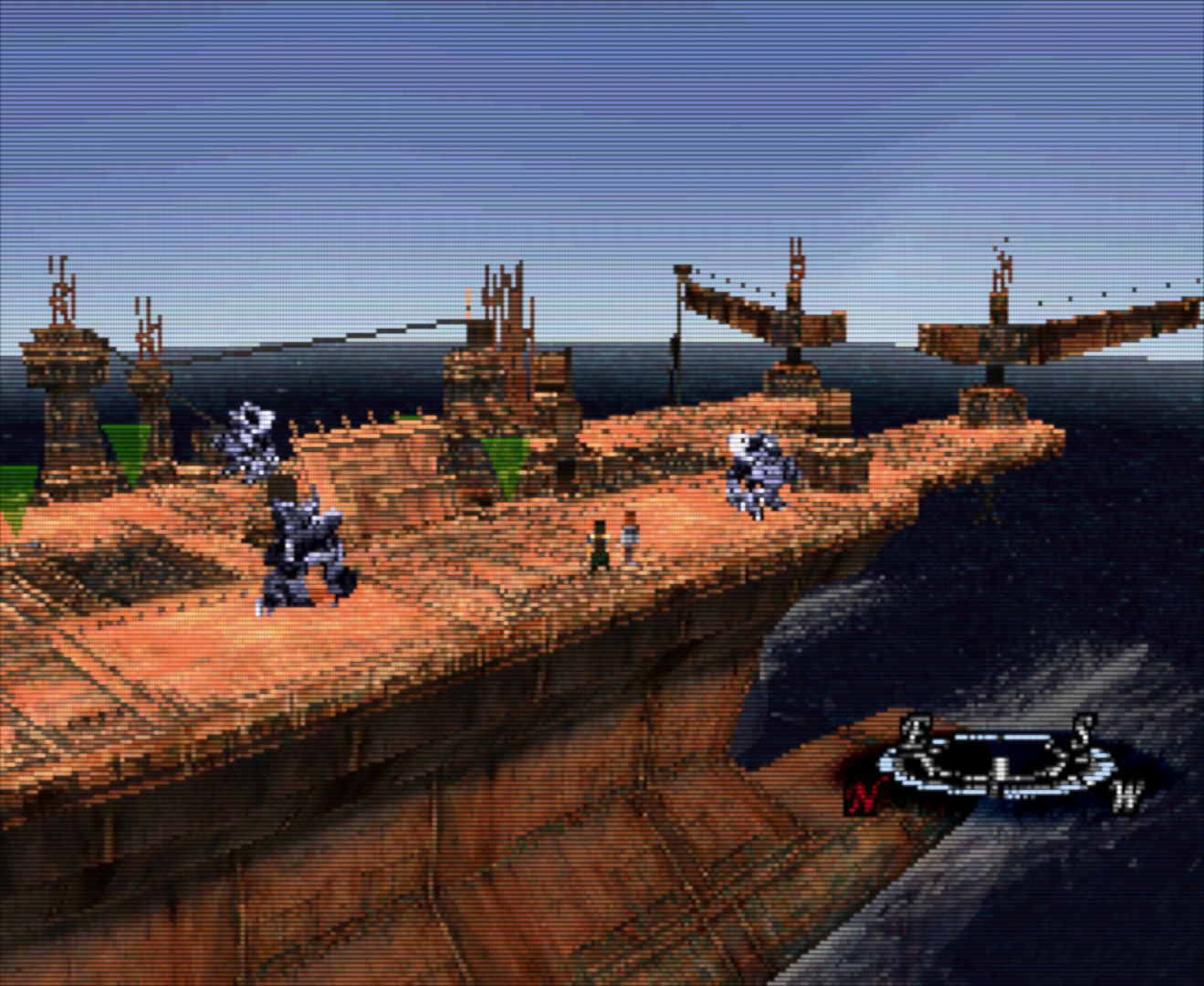
But to me, it makes up for it with the world. Maybe not so much in level design — which is fine, nothing special. But in atmosphere and variety? Absolutely yes.
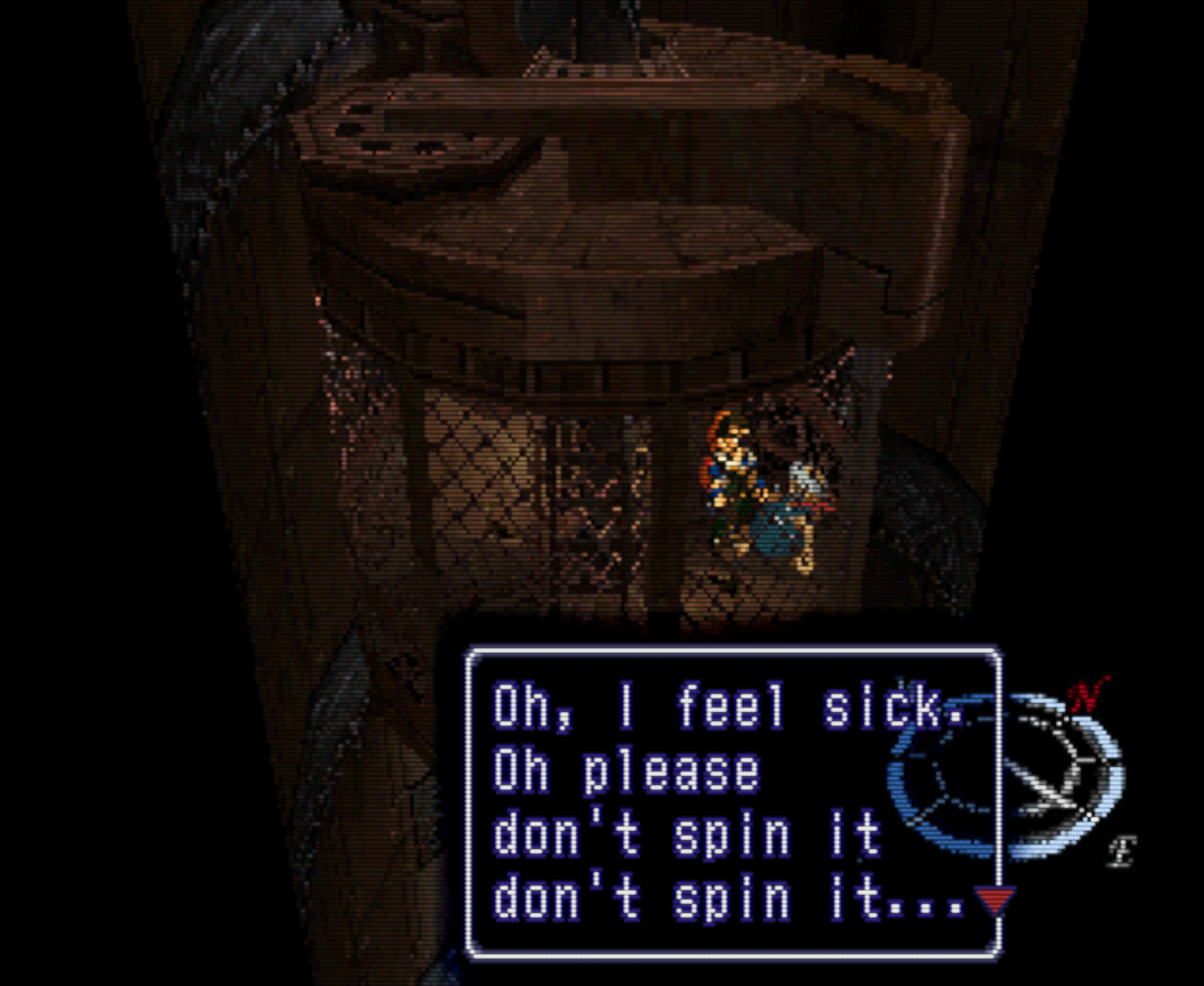
There is an eerie forest make of crystal.
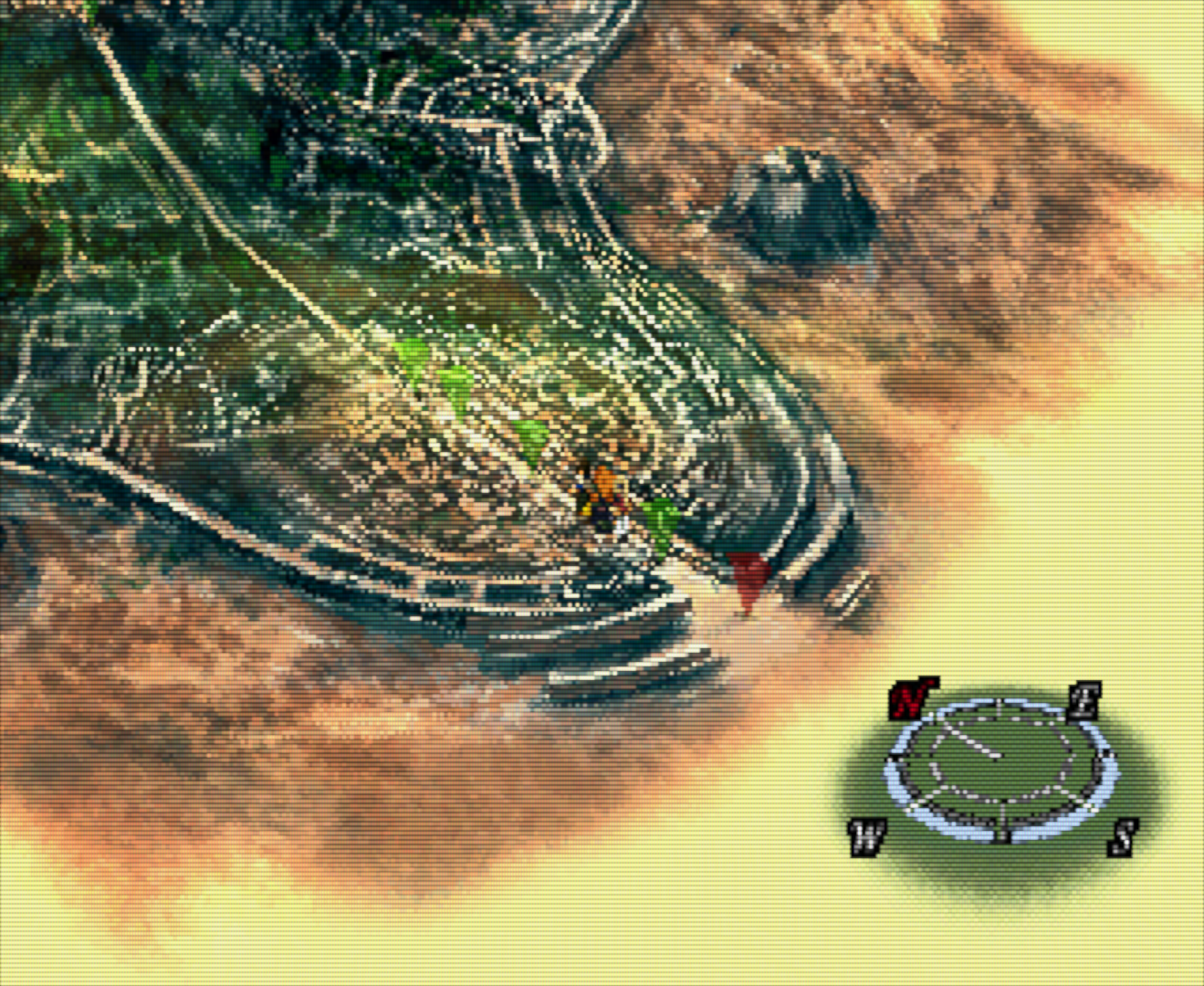
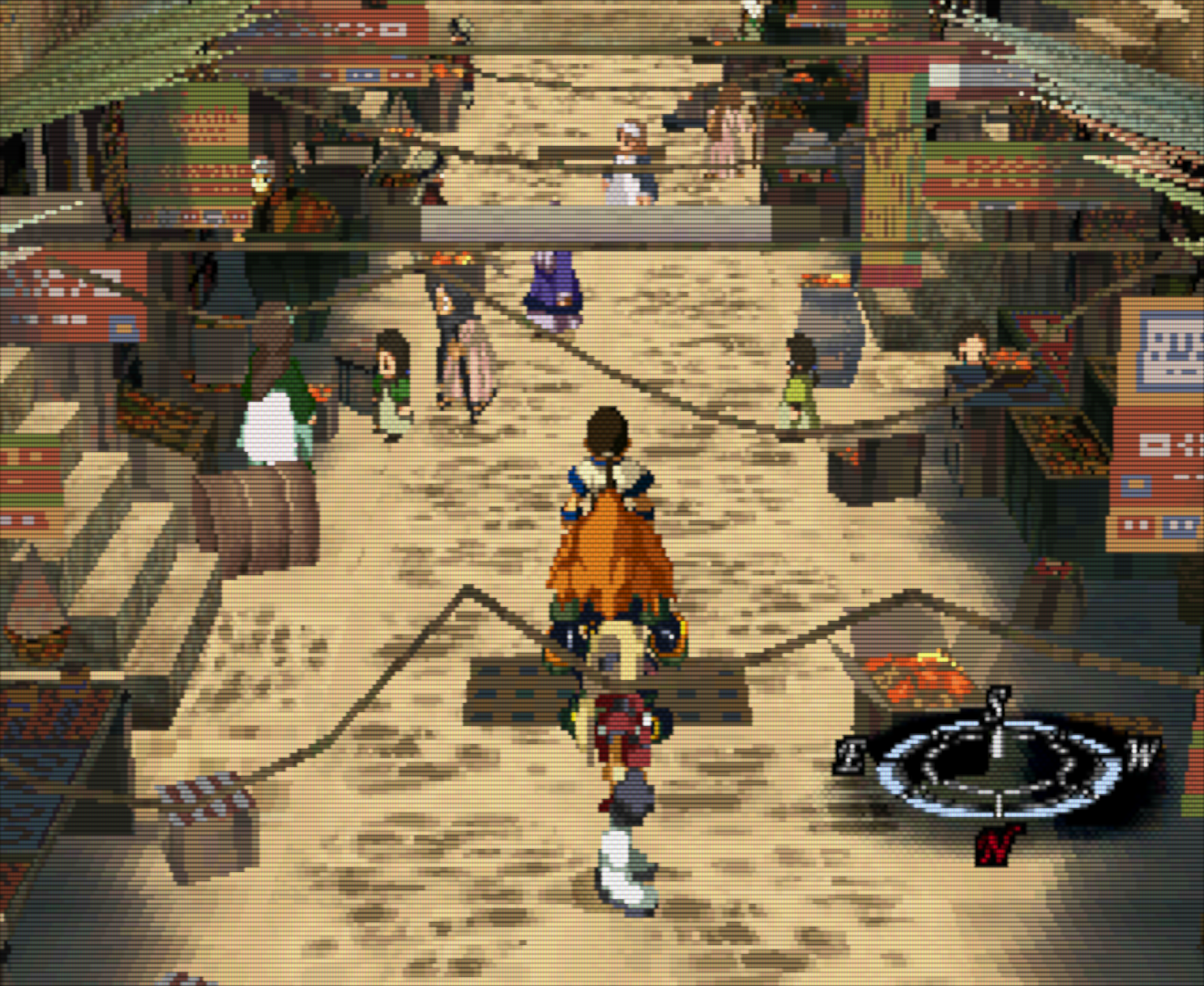
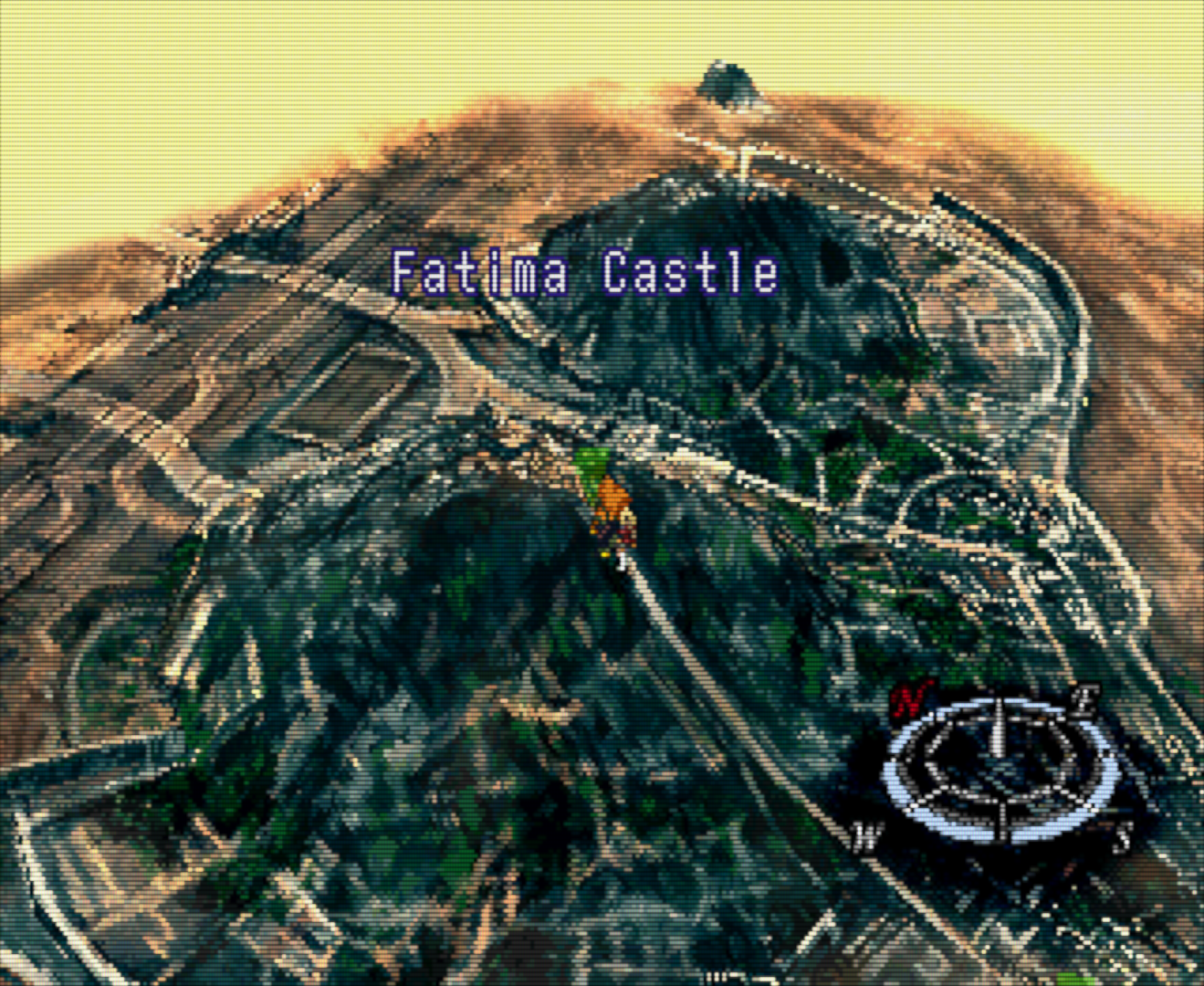
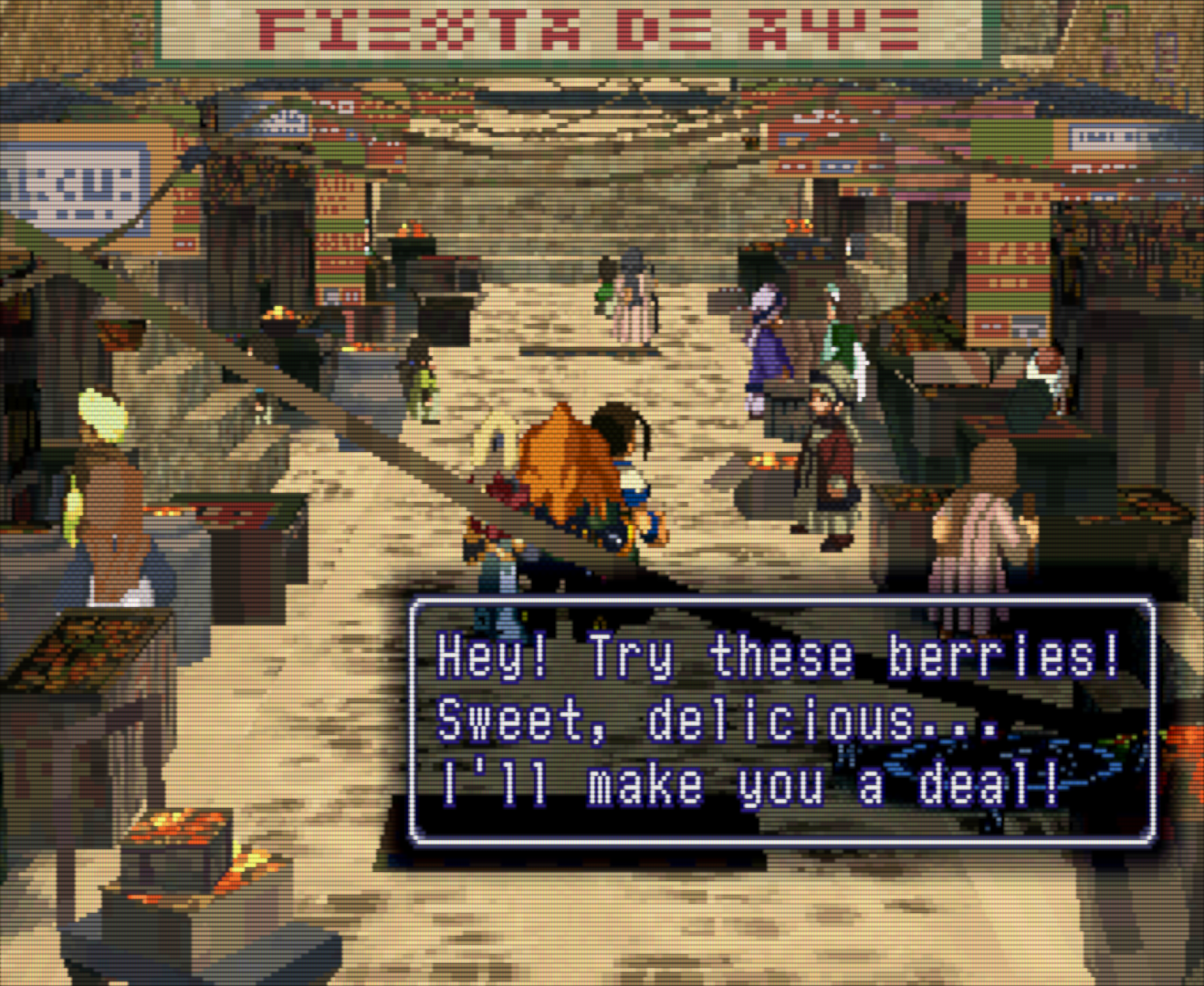
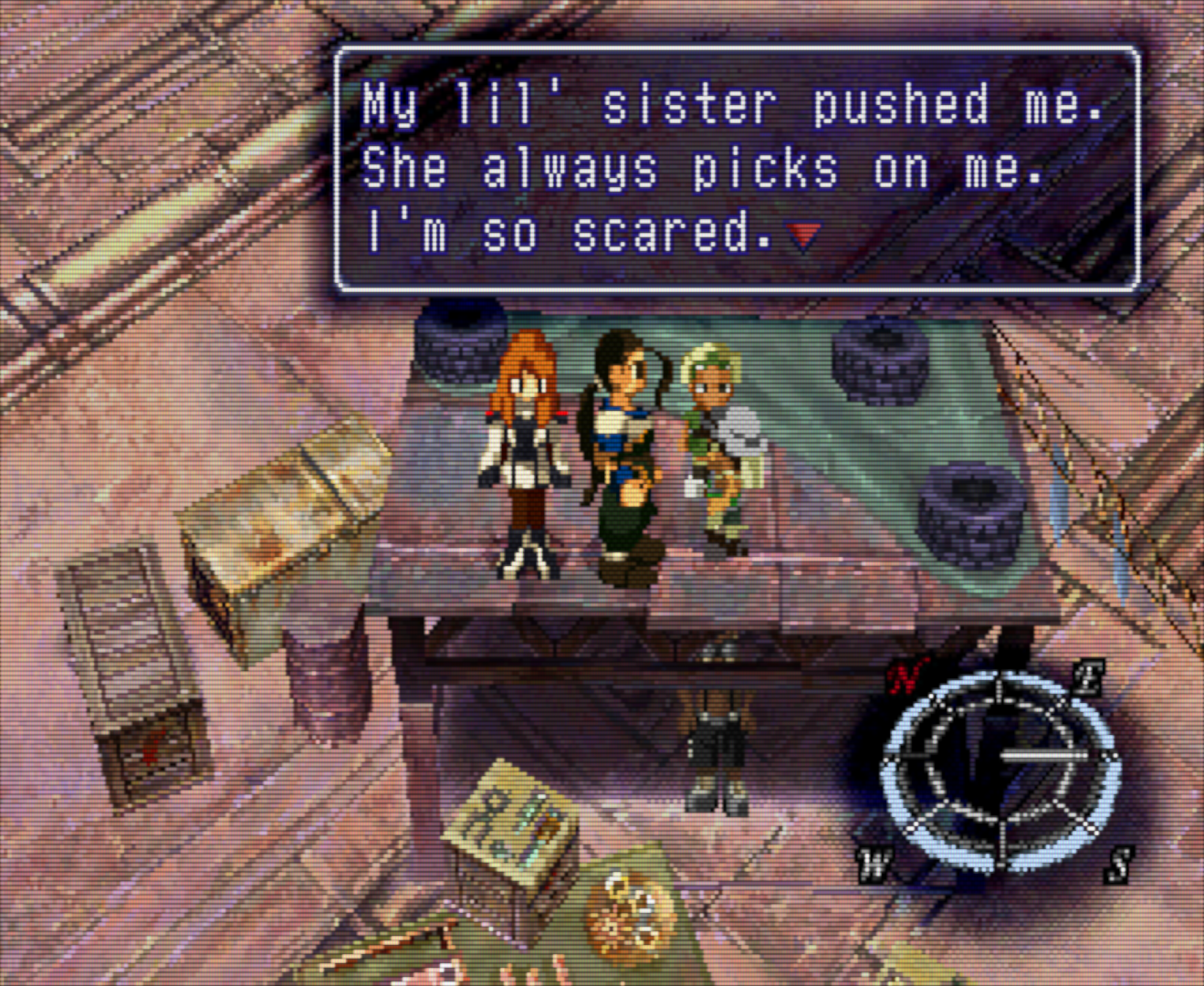
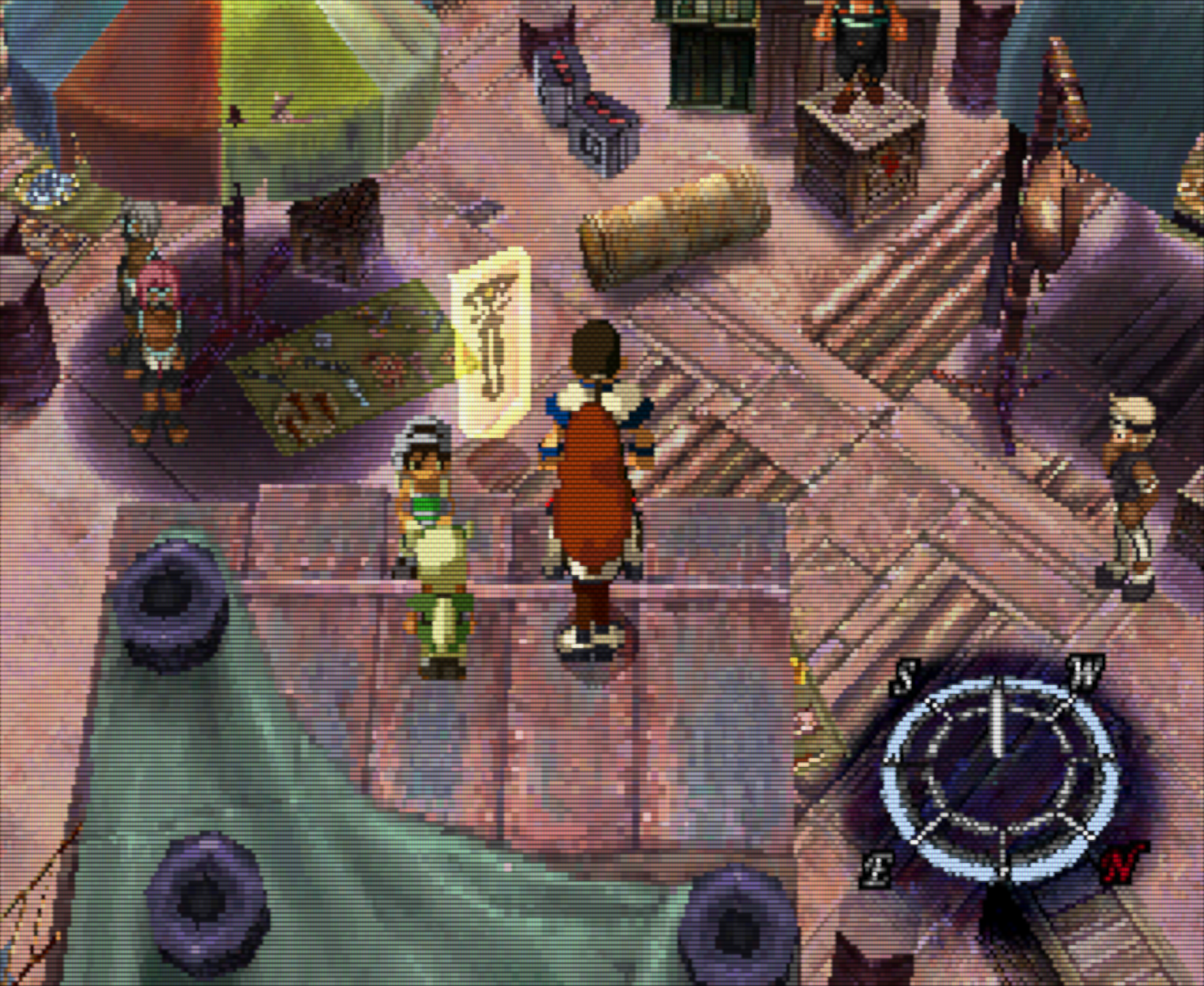
There’s a desert town, which seems downtrodden until you return the water, then everyone wants to party like they’re in Dubai.
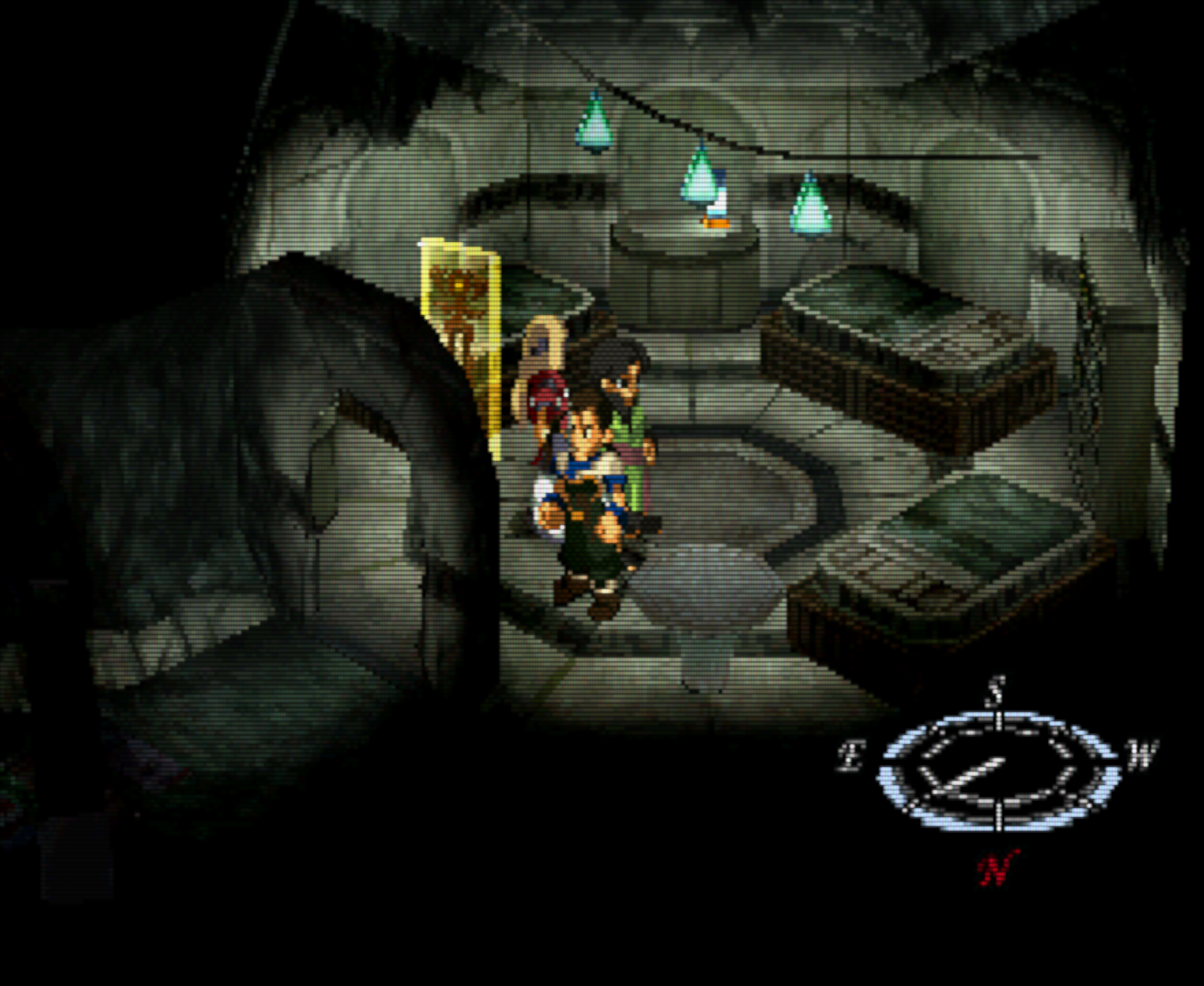
There is the mana forest, which haunting, dangerous, and vibrant.
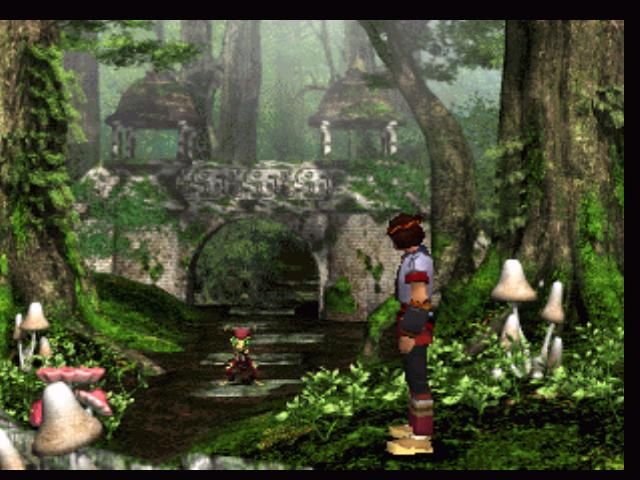
There’s even a cheery mushroom kingdom. Mario would be proud.
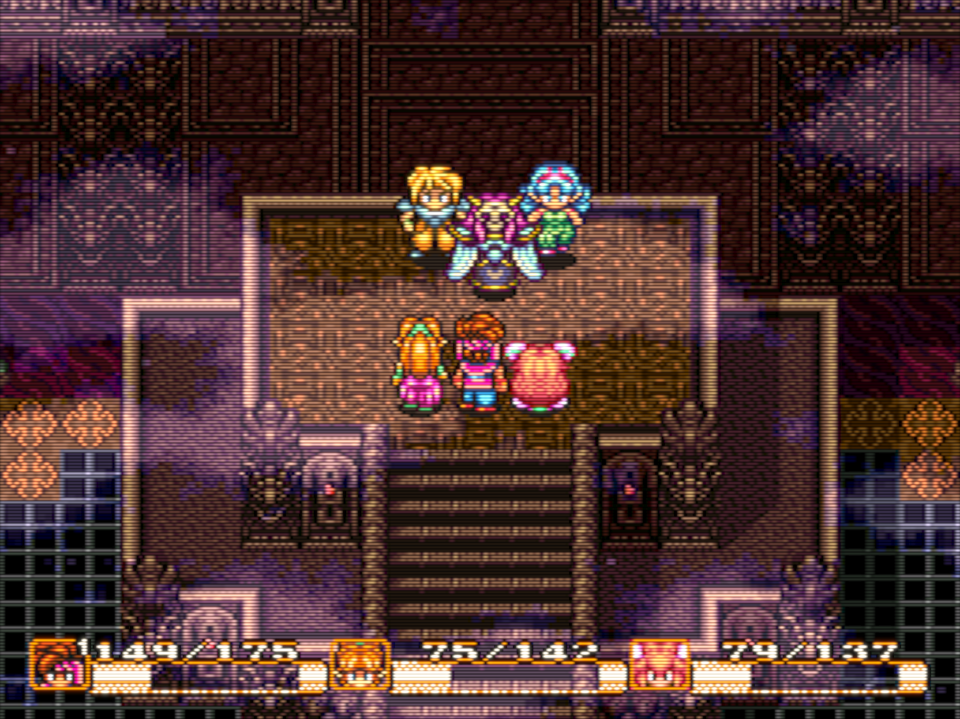
It’s a bit like Mario, actually: it might not have a story, but it has a vibe, and that’s enough to draw you into the worth. I’m fact, I don’t think any JRPG beats Secret of Mana for feeling sunny and adventureful. It comes out in the pixel art… and even more so in the music (composed masterfully by Hiroki Kikuta), which strikes an exceptional balance between chirpy and ethereal, truly appropriate for a light-hearted quest about nature and the threat of losing it. Indeed, that is the one theme that does shine through in Secret of Mana. Particularly at the end of the game, where the hero has a genuine dilemma to face, the one time that the storytelling matches — very, very briefly — the heights of the game’s audiovisual qualities.
This is a bit of an out-there comparison, but Secret of Mana reminds me of Diablo II. A real-time RPG, but not one known for its story or responsive combat mechanics. Rather, one that thrives on a finely tuned atmosphere and a satisfying sense of progression. That’s the lens Secret of Mana deserves to be seen though, and when you do, you realise it deserves to be known as a classic.
Additional observations
Spirit order: Once you get Sylphid, you can learn if an enemy has a magic weakness without trying each type. Before Sylphid, you only have two elements to experiment with. So Sylphid being the third “spellbook” you get access to makes a lot of sense.
The Pure Land difficulty spike: Progression is generally good in this game, but there is one difficulty spike that is handled very poorly. The enemies in the Pure Land hit mega hard, which on one hand is expected: it’s a narratively important area so it feels appropriate that it is dangerous and special. However, the only way to stand up to enemies here is to buy armour that is sold by a single merchant who is easy to overlook. I didn’t even know this armour existed until I looked up a guide, because I assumed I was missing something. This transition was rushed or otherwise underthought.
The shrine pacing: the first few shrines take a long time to get to, but by the time you’ve got four you’re probably ready to get to the end of this quest, so the last four shrines come one after the other in much quicker succession. This might also be an indication that the game was supposed to be longer but the second half was truncated, but in this particular way it works out for the best: it’s fun that the quest speeds up rather than gets dragged out.
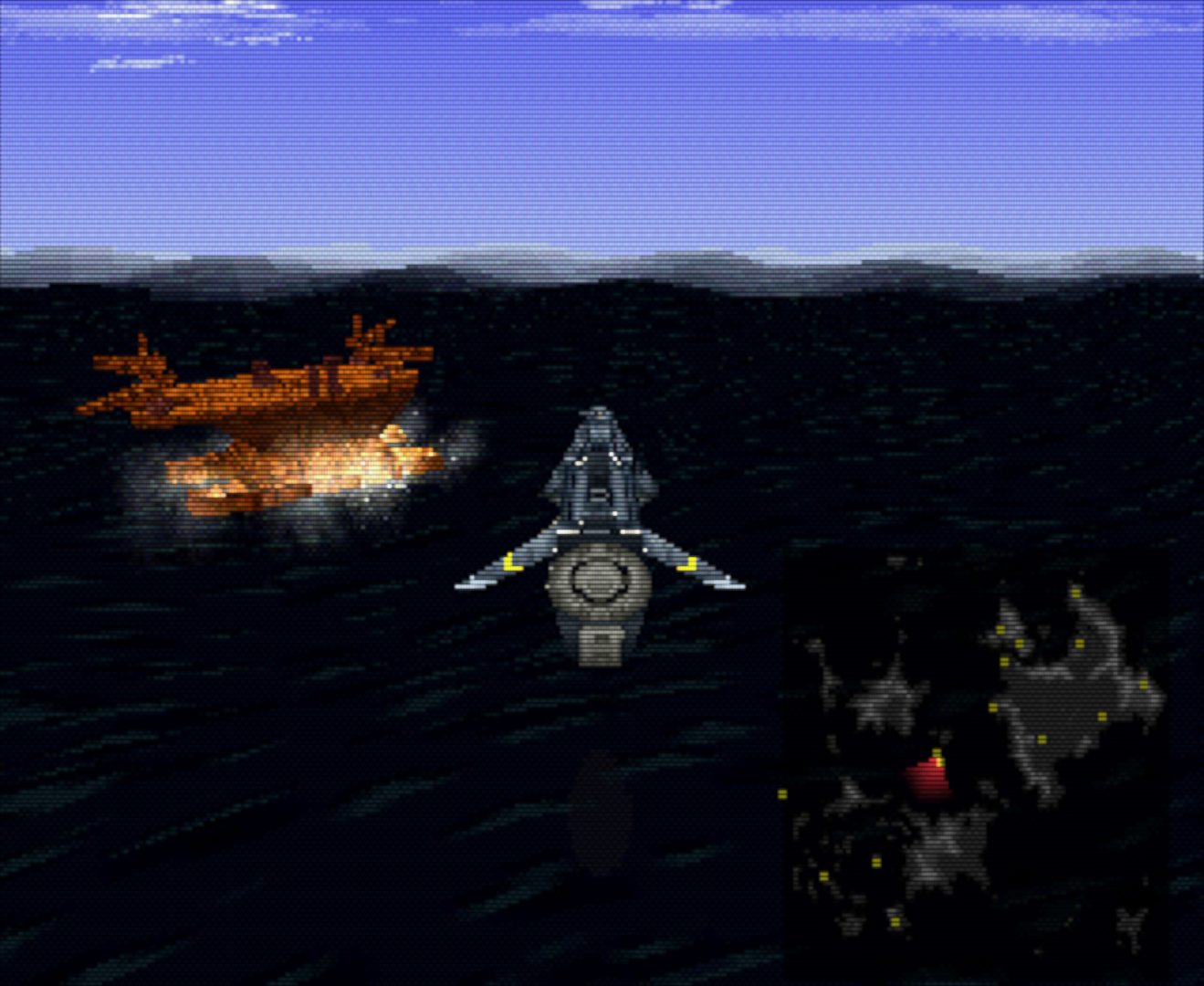
Flammie: Flammie is the best airship in a JRPG. He has a button that toggles between top down and from behind views as well as ascend and descend controls in both views. That makes Flammie the airship with the best controls and features in any SNES JRPG?! Also being able to call them from almost anywhere, not having to go to the world map and walk to find it again. He swoops out of the sky and picks you up wherever you are.
The Script Augmentation Project: The fan retranslation released as Secret of Mana: Reborn purportedly clarifies the story and adds events that were not included in the official Western release. As I already feel there is a hint of a great story in the Ted Woolsey script, I’m excited to explore this retranslation further to better understand the Secret of Mana lore, but I haven’t done so yet. Read more about this project on the romhacking.net thread.
Finally, let me leave this game for now by sharing this beautiful collection of Secret of Mana song covers organised by Rebecca Tripp and played by various musicians:
When I think back to the very beginning of the P3 project, I remember trying to accomplish two things: to create a worthy sequel to a great series, and to create the ideal hybrid of game elements to introduce a new RPG experience.
– Katsura Hashino, Persona 3 Producer & Director
Hybrid. I can’t think of a better word to describe Persona 3, a game of two halves in beautiful harmony, entangled but separate. There is a dungeon crawler and there is a social sim, and if you don’t like one of those genres it might be a deal breaker. However, if you can at least tolerate both, this game might become very special to you.
Persona spawned from the Shin Megami Tensei, a series of punishing dungeon crawlers about convincing demons to fight with you against other demons. Though Persona 3 reuses both the exceptional monster taming mechanics and the high difficulty, it pairs it with a captivating aesthetic, world and characters that the progenitor series lacked. That makes Persona 3 a double threat, sinking one hook into you with its style and another with its systems.
All this took me totally by surprise. As a JRPG veteran who thought he had a great understanding of what the genre had to offer, I didn’t expect to play one this year that felt like no other game I had played before.
This might have been because I didn’t have good enough points of comparison. There are other games that have done a similar genre mash-up, and I haven’t played them yet. The Sakura Wars series, for example, are half dating-focused visual novels and half tactical battles, and that sounds like a pretty close match to Persona.
And yet, I can’t shake the feeling that Persona 3 is something truly special.
Like the game itself, this review is split into two parts, plus a middle section about social links, the connecting mechanic that make this game work as a whole. Enjoy.
Part 1: A Game About People
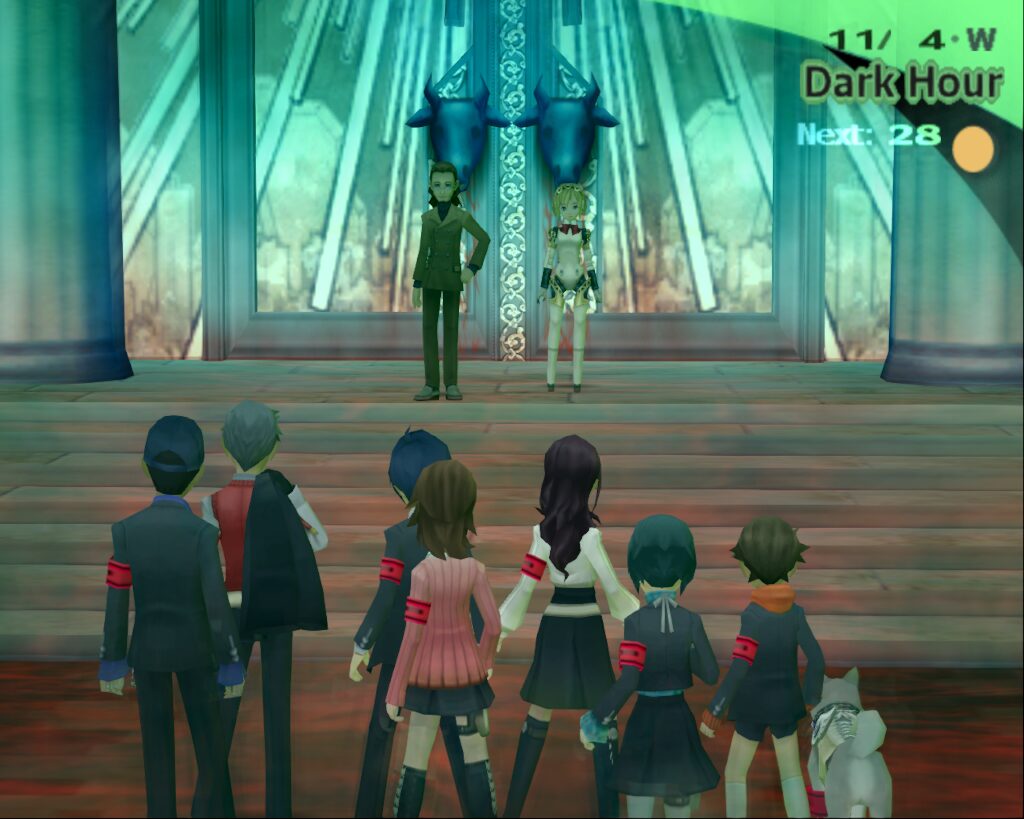
Your party are people
Persona 3 is partly a dungeon crawler. It has one dungeon, which is actually a tower, called Tartarus, that you return to again and again. You have a party, of course, who follow you through those dank halls. One common method that JRPGs use to might handle a party of followers is to hide them until a battle breaks out, though in other games your party follow you at all times.
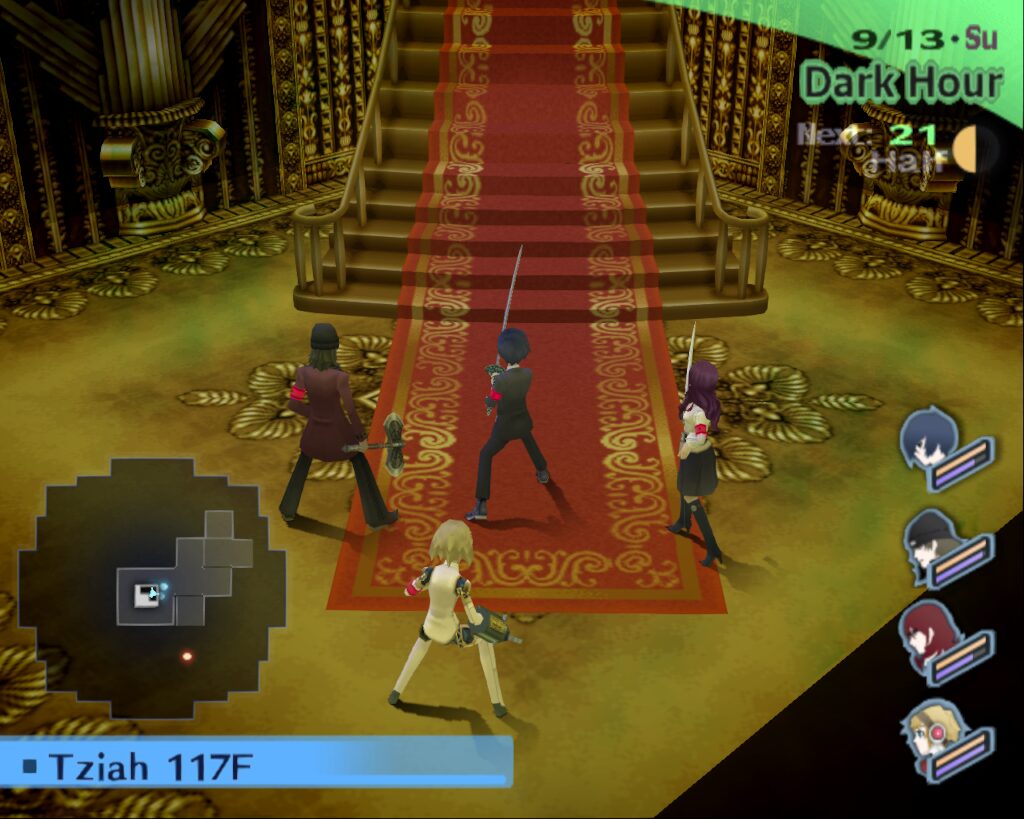
Persona 3 goes a welcome step further: each member of your party is a mechanically separate entity. They can be told to split up and explore the dungeon independently, opening chests and bringing you the booty (I was rarely brave enough take advantage of this option). They can get lost, and even end up in fights without you, agitating you to race to their rescue.
These characters are independent agents, and the game wastes no opportunity in conveying that fact to you. You can’t even access your party’s inventories from your own main menu: you have to talk to them. It’s one of the dialogue options. When you want one of them to heal the party, you talk to them. When you equip them with new items, they say thank you.
We become endeared to characters in JRPGs because of how they look, how they sound, and how they act. Persona 3 ticks off all three, with exceptional voice acting and beautiful character portraits that I never stopped enjoying even after 100 hours: these are portraits that stand up to 1000 views.
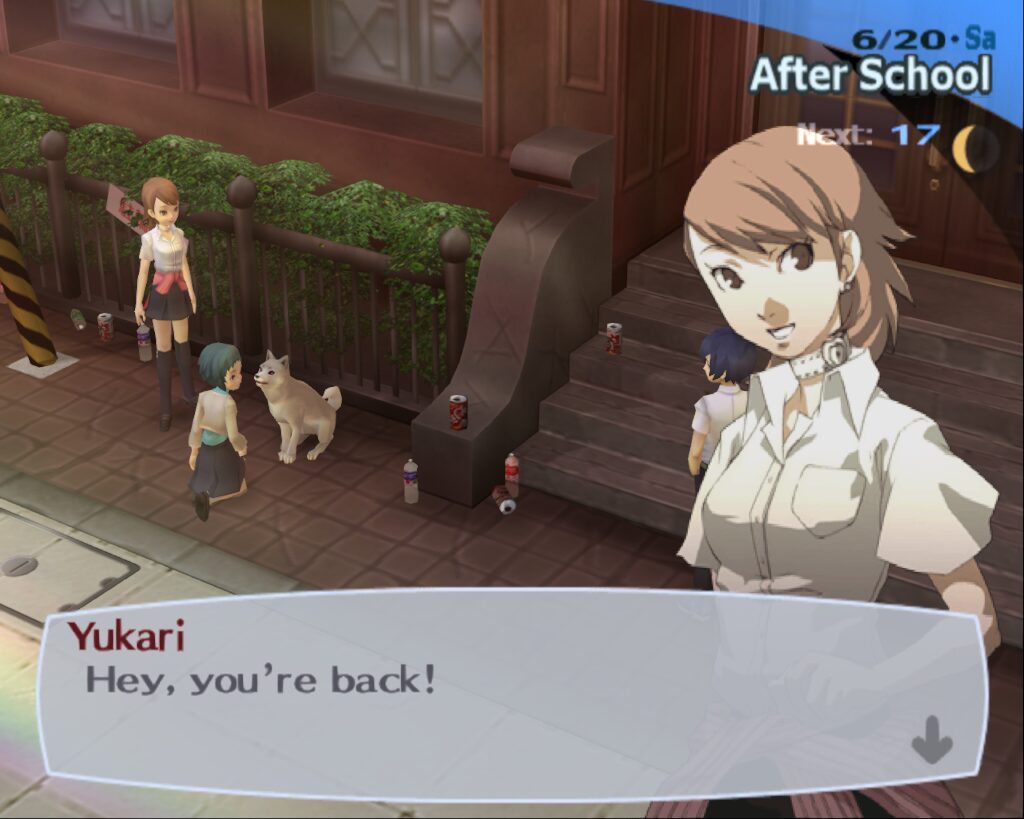
But it isn’t the individual parts, but how they are consistently implemented across all levels of the game that makes Persona 3 special. When you are in a battle, characters do not lose their personality: it is only another opportunity for them to express it. When Iori says “Keep it up Yuka-tan!” when Yukari gets a good hit on the enemy, I think about what a great little team and social circle I am part of here.
The most fundament example of your characters acting like people is that you cannot control your party’s actions in battle — at least, not in the original release of the game. Rereleases offer the option of full party control, though I’m more fond of the original implementation. The developers were sticking to a theme, and I respect that.
Your demons are your party
Another way in which Persona is a hybrid game is that is has both the appear of a traditional JRPG, starring a colourful cast of human party members, as well as the appeal of a monster-taming game with an army of demons to do the fighting for you.
Those demons are inherited from Shin Megami Tensei, Persona’s parent franchise, which is a bit like Pokemon for masochists. Persona 3 is by no means an easy game either: it demands that you create strong monsters and makes it a pleasure to do so. Fuse a new monster when you have a social link associated with the correct aracana, and the new monster will receive a waterfall of experience, levelling up multiple times in a row and obtaining higher-level abilities without a moment of grinding needed.
That’s something you get in SMT games but not in Pokémon. You can use your new monster and they are effective immediately. There’s a trade-off, though: you don’t keep a monster long enough to form a strong bond with them, like you would with a Pokemon. You enjoy their company and their power, then you trade up. They are temporary friends only.
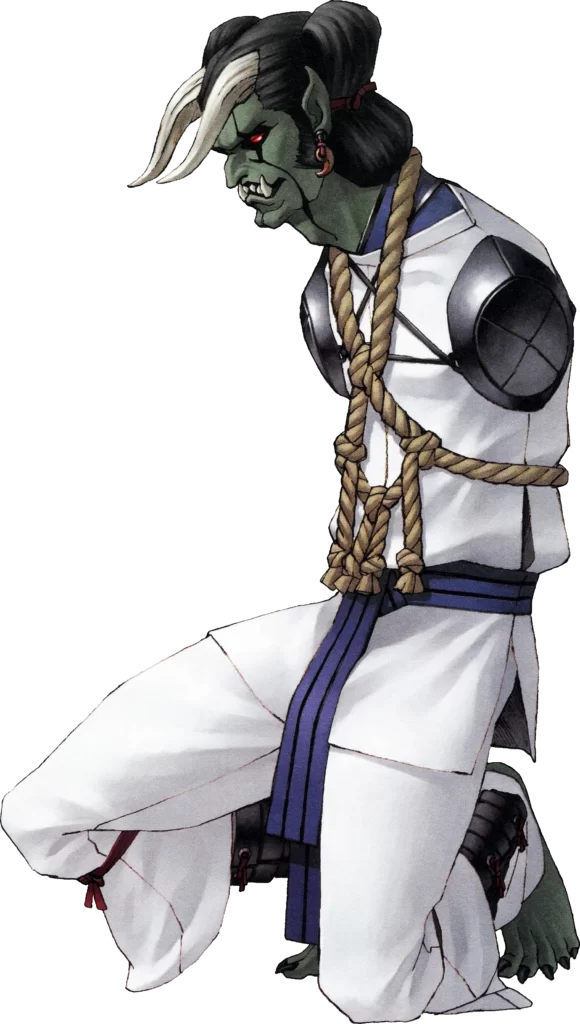
Though these connections are brief, they can be meaningful. At the top of the second block of Tartarus me and my party met groups of nasty beetles that hit for big physical damage. They killed me a few times. Back in the purple room, where you fuse new monsters, I noticed one that had good lightening skills, which the beetles were weak too. Plus, I could fuse him with passive abilities that increased my defence, allowing me to tank the deadly horns of my foe. Plus, this new monster looked very cool. I brought him into battle against the beetles and he made short work of them. When I ordered him to attack, the main character even shouted his name: “Take-Minakata!” Why can’t Pokémon games do that?
Take-Minakata
I know I would replace him after a few floors, but for that moment I was extremely pleased with my strong new monster, and felt a bond with him. That’s what makes the heart of a great monster raising game.
Demons drive the mechanics of the game, but they are fenced off there: they are rarely relevant in the story, except in a generalised way. Each character has a unique persona (the correct name for the monsters they fight with), but they have no individual personality or role.
It’s almost if these monsters were only a Alice In Wonderland-like metaphor, and it makes me question if this is a game about monsters at all, or if they are just a obligatory carry-over from the parent series.
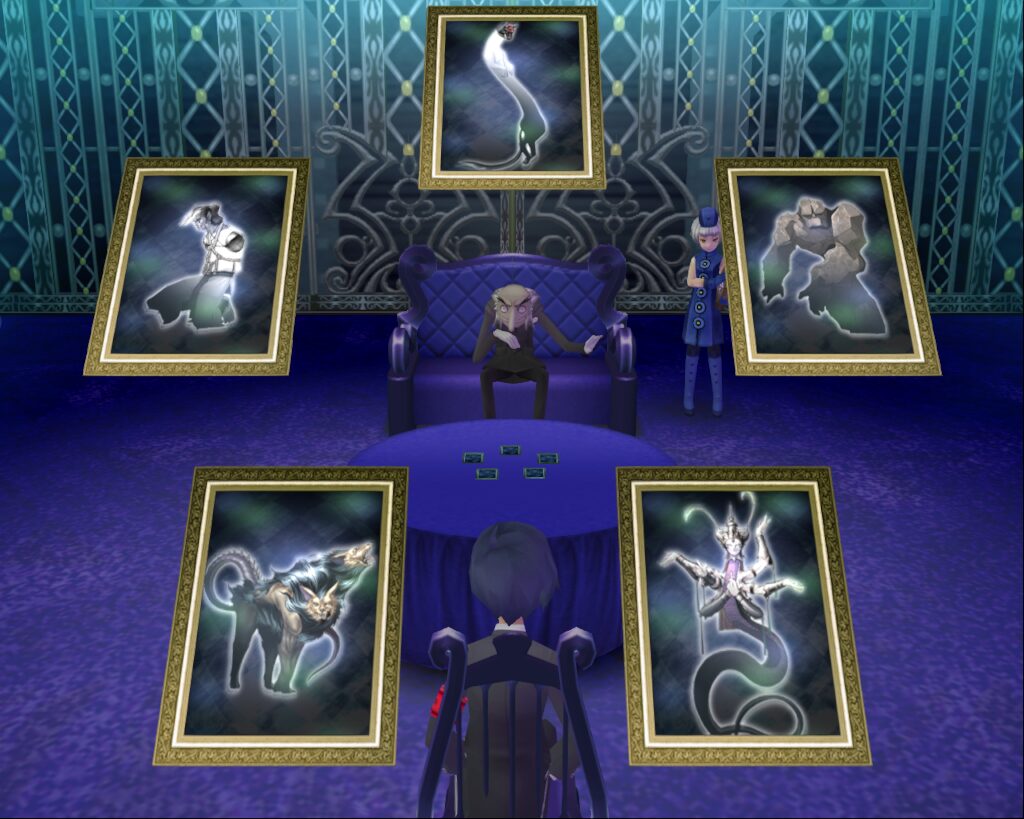
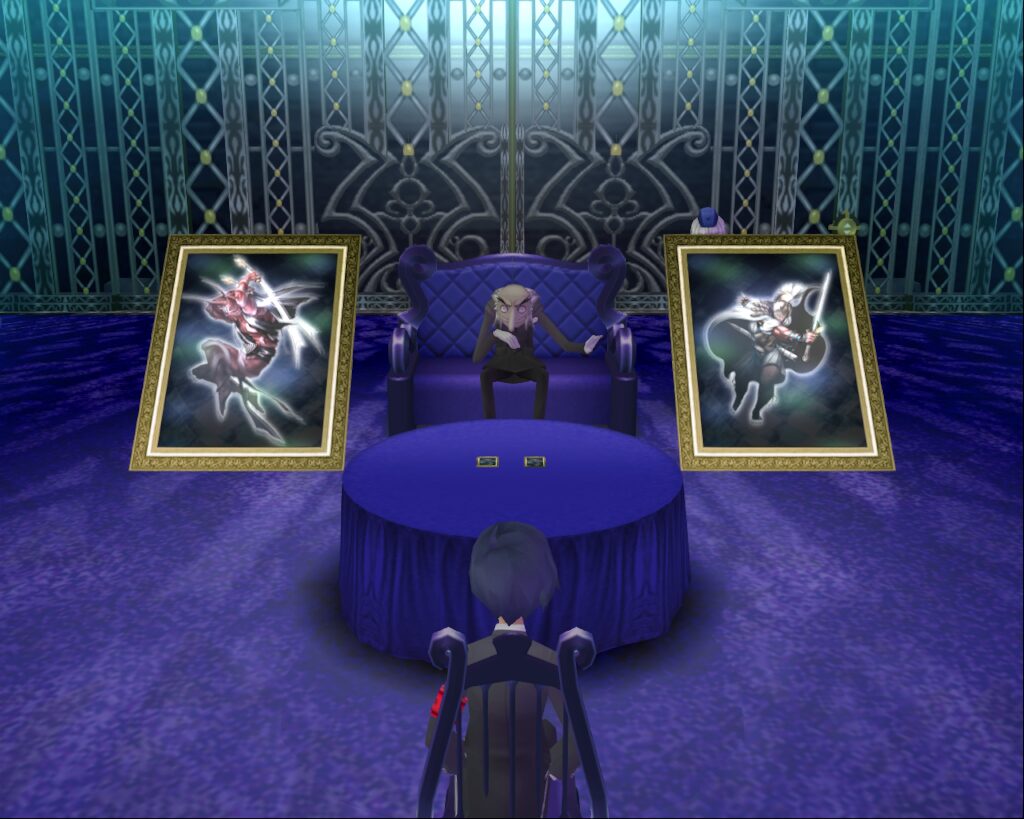
A pentagon spread (five-demon fusion) with Inugami, Take-Minakata, Orthrus, Vasuki, Ubelluris performed by Igor in the Velvet Room of Persona 3
Would the game be meaningfully different if all demons were replaced with spells? I don’t think so. They add to the atmosphere and they support the mechanics, but that’s about it. They are superficial, and that’s fine: this game isn’t about demons.
Sense of place
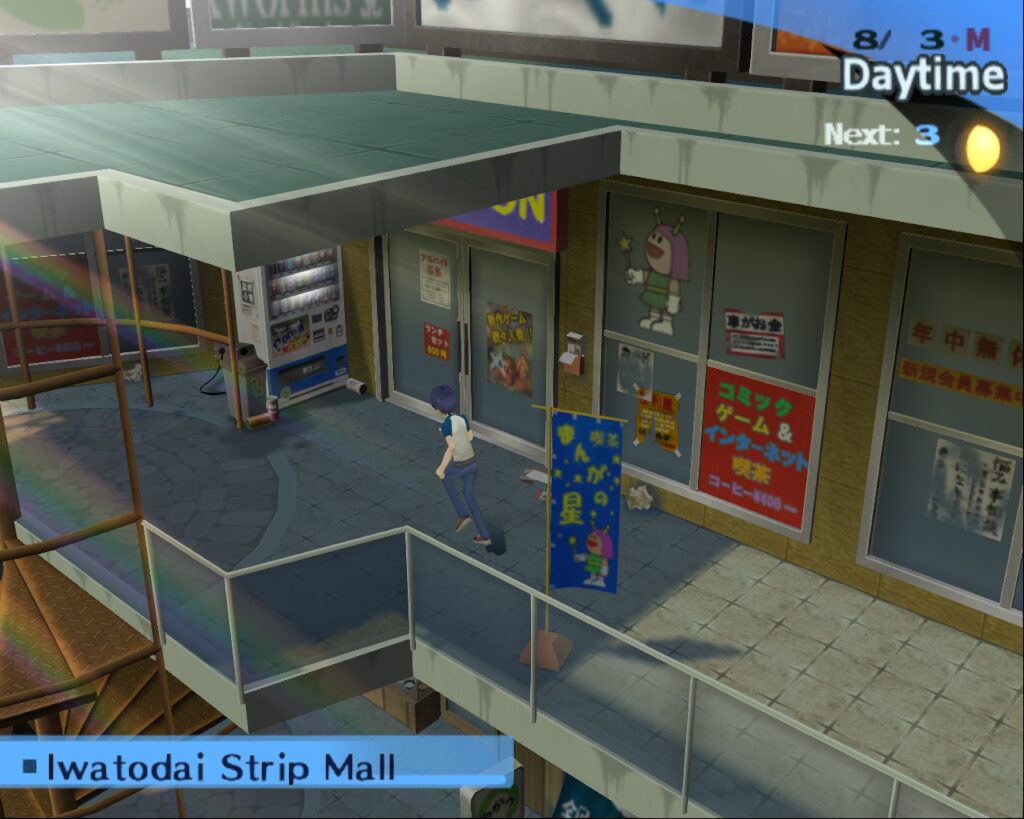
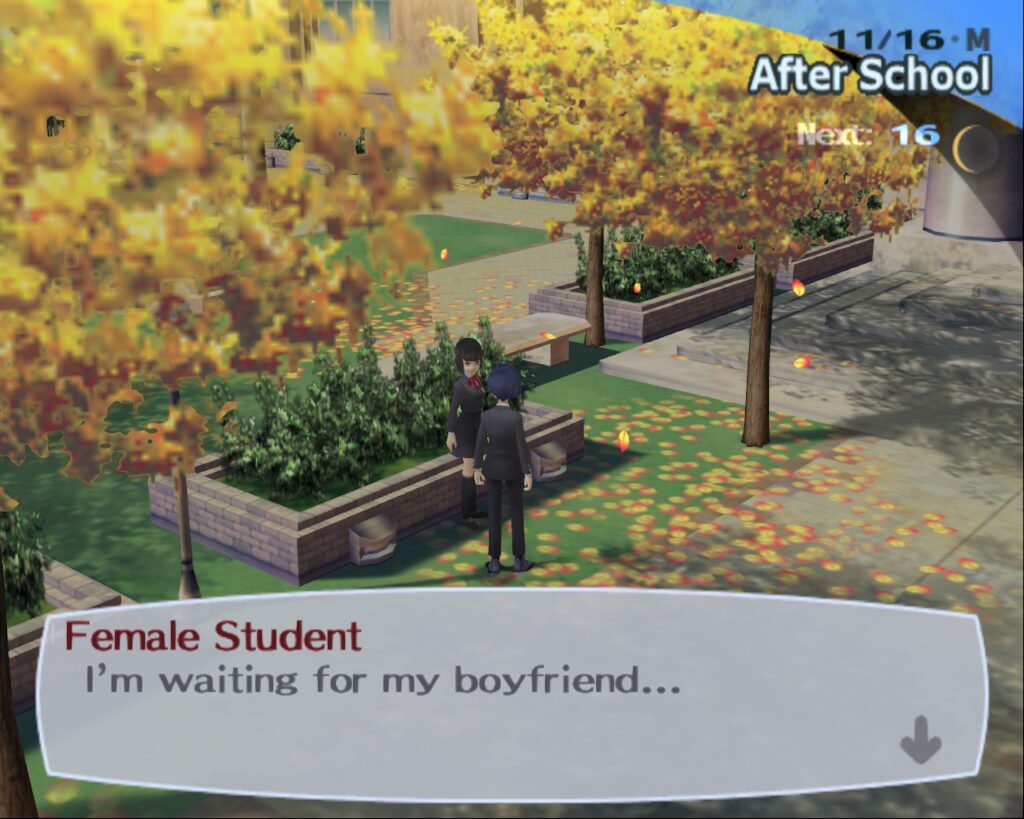
If not demons, what is Persona 3 about? While we try and figure that out, let’s take a walk through the town. Persona 3 takes place in Iwatodai City and Tatsumi Port Island. Your characters are high school students and must spend some of their time in their lessons at Gekkoukan High School. If you join the swimming team, you might visit the pool after school, which glistens as it reflects the overhead sun. As you leave the school, passing gossiping students at the water fountains, you pass are shelves at the entrance that overflow with student’s shoes.
Each detail in the world feel true to life. That goes for the surrounding town, too. The ramen restaurant, the fast food restaurant, the book store, all these tiny locations have a unique atmosphere to them. I want to visit these places. I want to drink coffee in Chagall Café. I want to sit on the lawn by the persimmon tree. I want to walk the dog in the shrine and run into somebody I know on the way.
Just like in real life, in is in these regular places that you find peace, and in these pointless moments that you find pleasure.
Time is your enemy
Days pass and winter turns to spring, at which time the characters no longer take their jackets to school with theim, and at the weekend they wear lighter casual clothes, too. Though you path you walk to school hasn’t changed, the music has, and the cherry blossoms are blooming.
Persona 3 takes a lot of care in portraying the passage of time. That because the whole game is based around it. You play this game day-by-day, and when you have taken your last action for the day, you go to sleep, and the date changes – unless you enter “the dark hour”.
The dark hour is when demons called shadows walk the streets freely, and most humans are frozen in place. If you end the day by entering the dark hour, a ticking clock counts down to midnight and then… shatters.
Early on, during the dark hour, you are visited by a mysterious boy in striped clothing. He tells you this: in one week you will face your greatest challenge yet.
One week is no simple narrative device in Persona 3. That is a week you have to live though, choosing what to do with each of your days. Which friends do you spend time with during the day? Which nights do you train and which do you rest? Do you continue to study, or leave that till after the challenge?
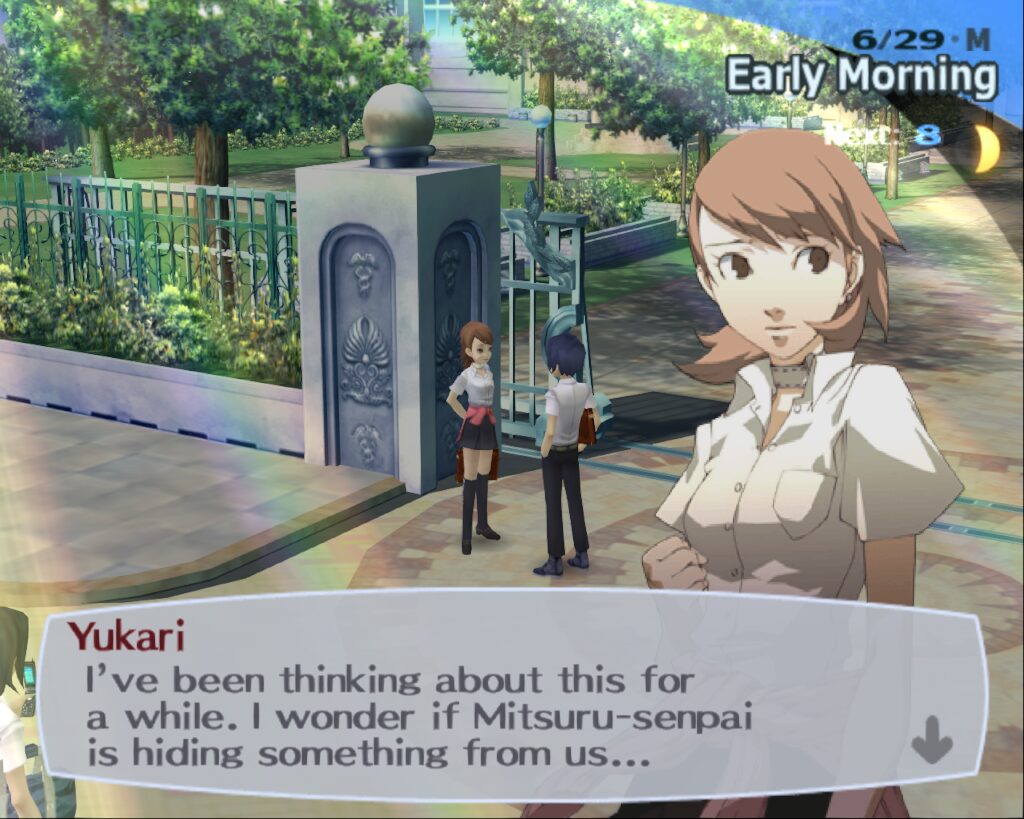
In the days before the big challenge, the usual chirpy music at the school gates turns ominous. The friends you pass there confide their fears, doubts and determination.
Unlike a traditional JRPG, time can be “lost”: you have a number of opportunities each week to spend on stat-building activities, and if you waste them you cannot get those opportunities back. You cannot go back in time. Vacation and the school trips last a set number of days, and when they are over you cannot return to those locations. Similarly, you can’t speak to your classmates during the school holidays, so you spend time with them while you can.
Much later, the game puts its skill at crafting atmosphere to make something chilling. The world turns cold, crazy and depressing, and you walk through the mall where you used to go to sing karaoke, where it has a wallpaper of cult flyers, and human sufferers of apathy syndrome stand as static as furniture, and it is a sad sight.
You always want it make the most of what time you have, both in terms of being efficient about building social links, social stats and levelling in the dungeon, but also making the most of your time in this world with the characters, before something dreadful happens.
The message of Persona 3 is trite if you spell it out, but the game doesn’t spell it out. It makes you experience it, it makes you live it though how you play the game and how you experience the story.
People are your world
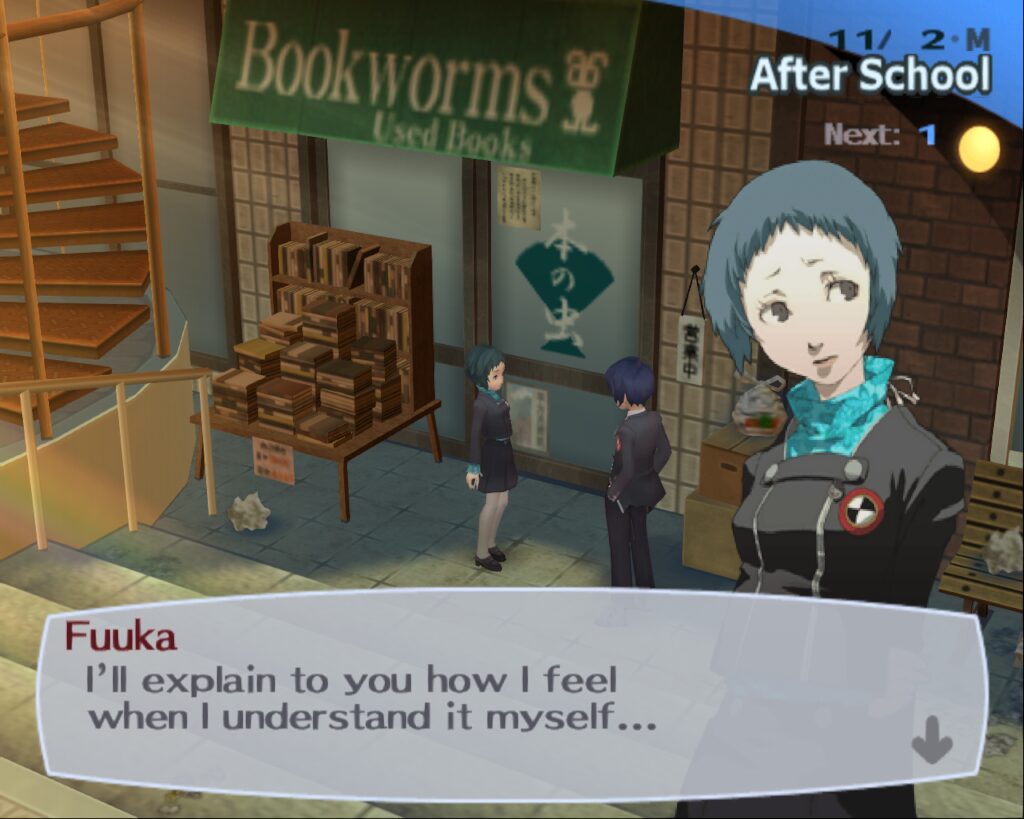
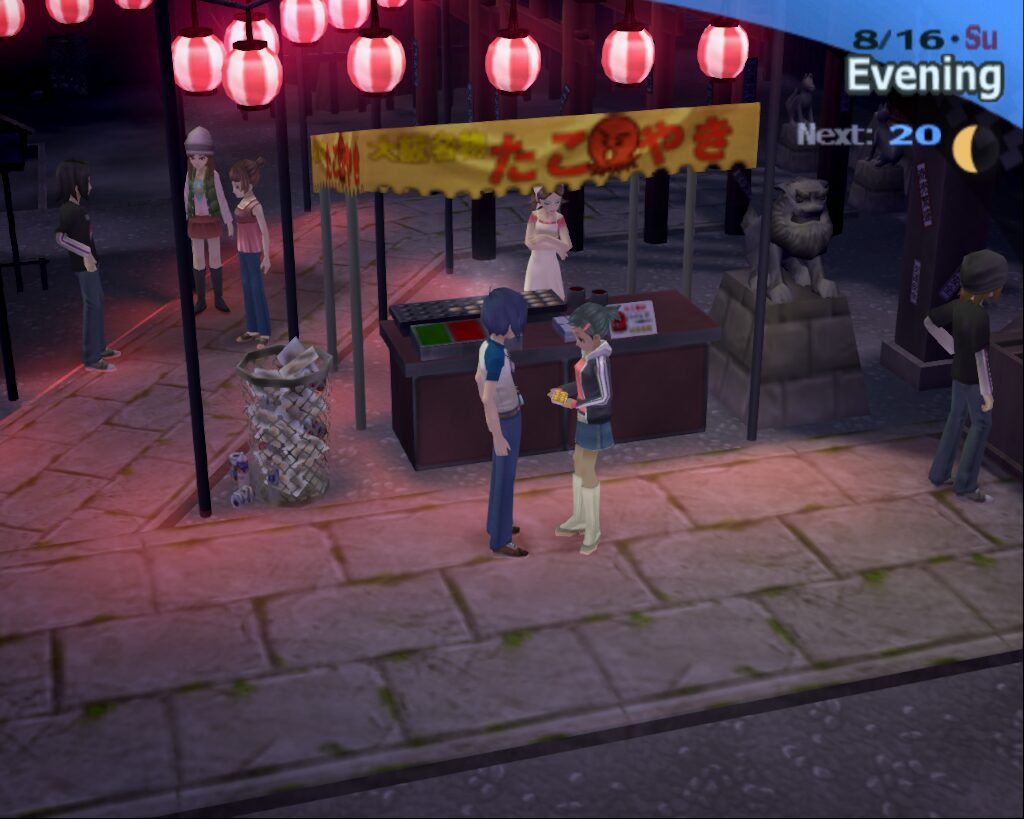
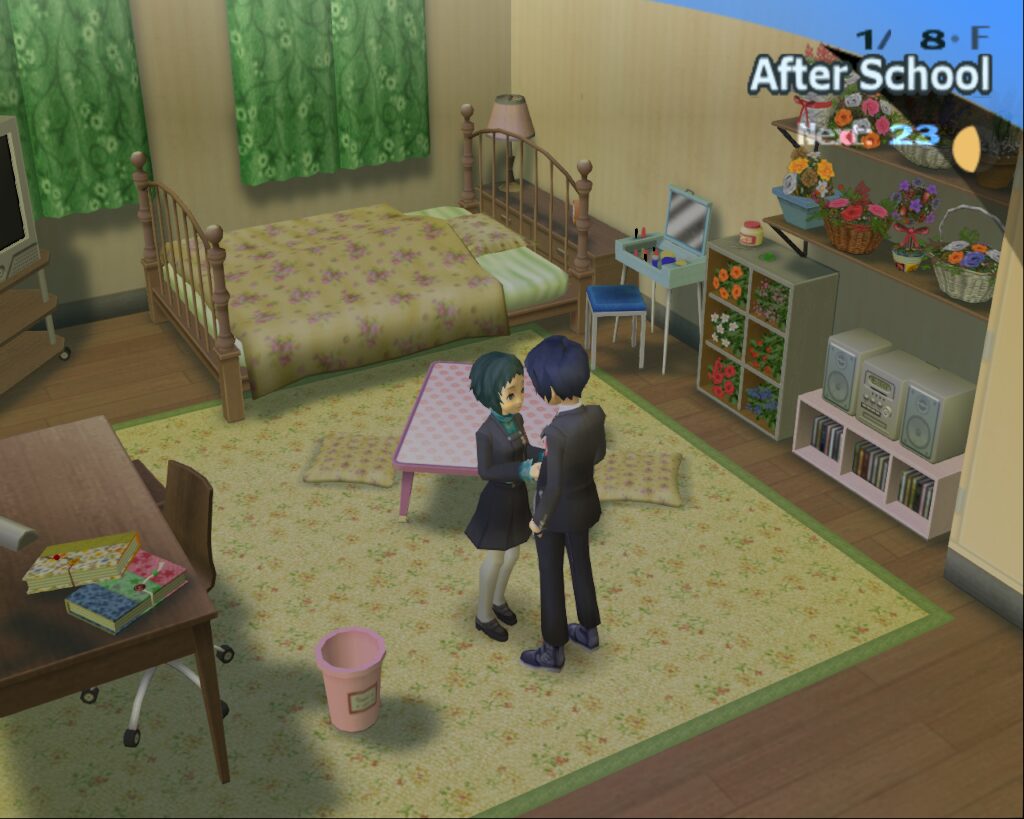
Take a stroll to the shrine in the evening, and you will run into Meiko. She is one of the many residents of Iwatodai City that you can build a “social link” with. Each time you spend a slice of your day with these characters, and you will live a small chapter of their story, learning about their challenges, flaws and futures.
What sets Maiko apart from the other social links, who are all teenagers or adults is that she is nine-years old. For a long time, I was reluctant pursue the Meiko social link because of this. It felt too strange to be hanging out with an nine-year old school when character I was controlling is in high school. It occurred to me how ridiculous that would look to my classmates and who suspicious it would look to any adult passers-by.
The fact that this even occurred to me is a clear sign that this game had deeply immersed me in its world.
Eventually, I started using my time to talk to Maiko. It wasn’t long before I sympathised with her story, which revolves around a precarious home situation.
I started thinking way too seriously about how to respond to her so that I didn’t upset her or give her harmful advice. At one point, she starts crying, and the options are “Tell her to stop crying” or “Let her cry it out.” That’s a tough one.
Social links usually just progress, but they can also be broken. I was left gaping the first time this happened. Yuko, the captain of the swim team, is one of the romanceable characters. As the social link progressed, our conversations became more intimate. However, I must have gone too long without speaking to her, because she broke up with me.
When I got back to the dorm, I wanted Junpei should give me a slam on the back and tell me better luck next time. I wanted Yukari to be sympathetic. I wanted Akihiko or Mitsuru to give me some practical advice. Of course, that’s expecting way too much from the game, which does not react to my loss. Nonetheless, the emotion I felt was quite real.
Now I have reason to be concerned. Have I unintentionally activated a degenerate part of the brain gets overly attached to fictional characters? How long before start talking about waifus unironically?
Fuuka > Yukari
Part 1.5 The genius of social links
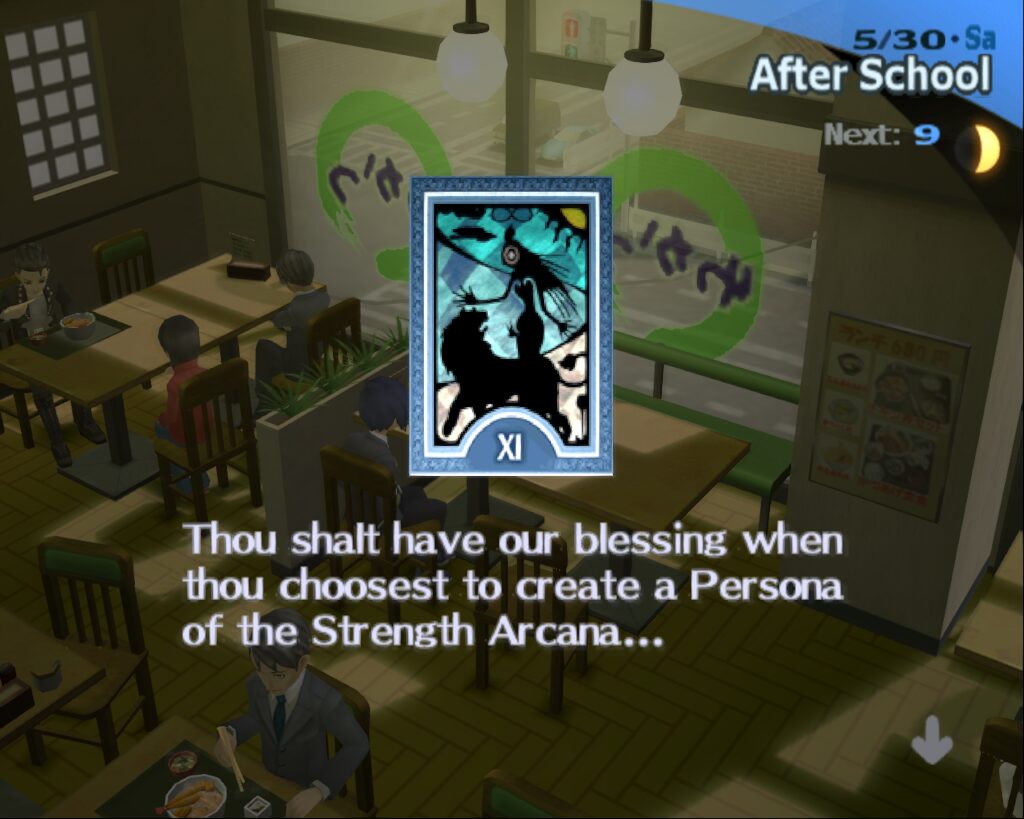
The early steps you take into Persona 3’s “real world” (the half of the game in which you have school work and a social life) introduces you to some curious game terminology. After you progress a socia link, time stops. There is the sound of glass breaking. Unsettling music plays while a mysterious card appears on the screen, and you are told that you now “Create Personas of the Fool Arcana” up to a certain level.
This dramatic version of a “level up” is part of what makes social links addictive to pursue, but at first it is confusing, because the game hasn’t told you what an arcana is or why it matters.
Soon, you discover that arcana are how the two halves of Persona 3’s gameplay slot together, and it’s a brilliant mechanism. The reason you build up social links in Persona, (other than to hear a selection of stories about depression, disconnection and growing up), is to be get bonus experience when you fuse a monster. The higher the social link level, the more bonus EXP gained by demons matching that arcana.
For example, spending time with Meiko means stronger demons of the Hanged Man arcana, and spending time with Yuko means stronger demons of the Strength arcana.
It’s a JRPG, there is a lot of dialogue, and the relationships you build through dialogue in the “real world” translate to increased strength when you enter the dungeon. That character development is the story is also part of your training. It’s mechanically relevant.
This is easily my favourite mechanic in Persona 3, and maybe my favourite mechanic in any JRPG ever. If Persona 3 was the first JRPG to do this, it’s quite incredible. It’s a genre in which story and battling are bread and butter, but Persona 3 seems to be the first one that buttered the bread!
Part 2: Mechanics
Battles
Let’s go back to the dark hour. At the stroke of midnight, you can choose to enter Tartarus, This is the game’s solitary dungeon, where shadow roam through twisted hallways and the floors go up seemingly forever.
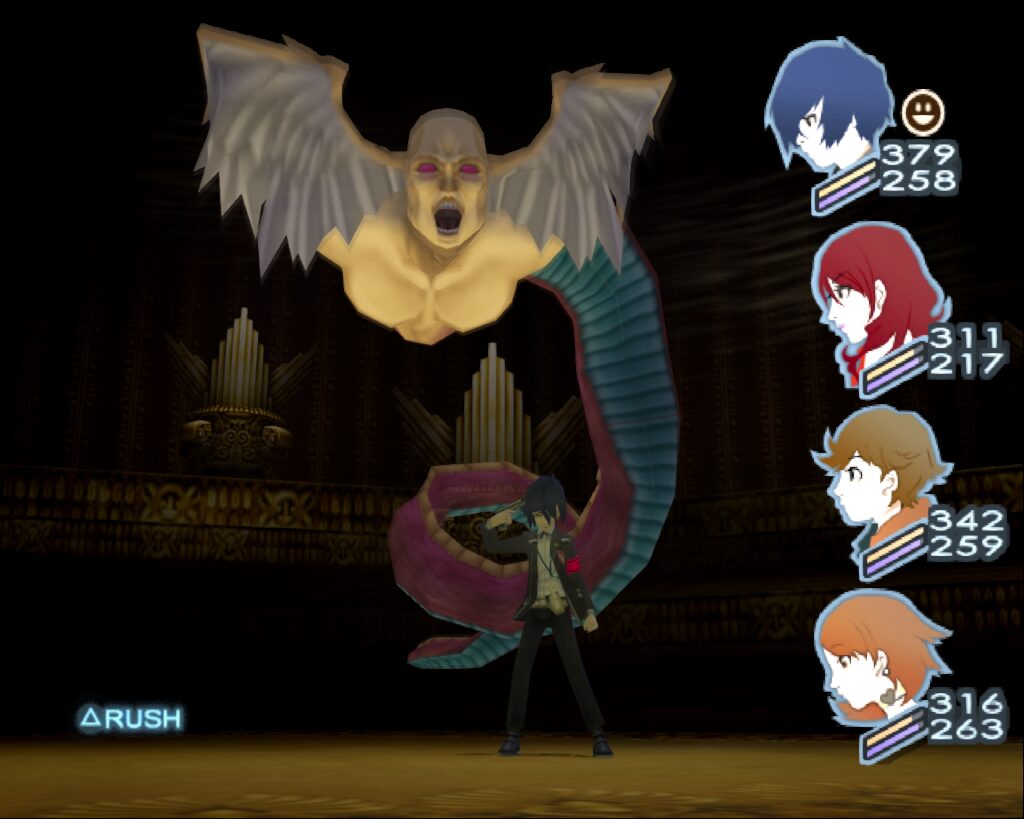
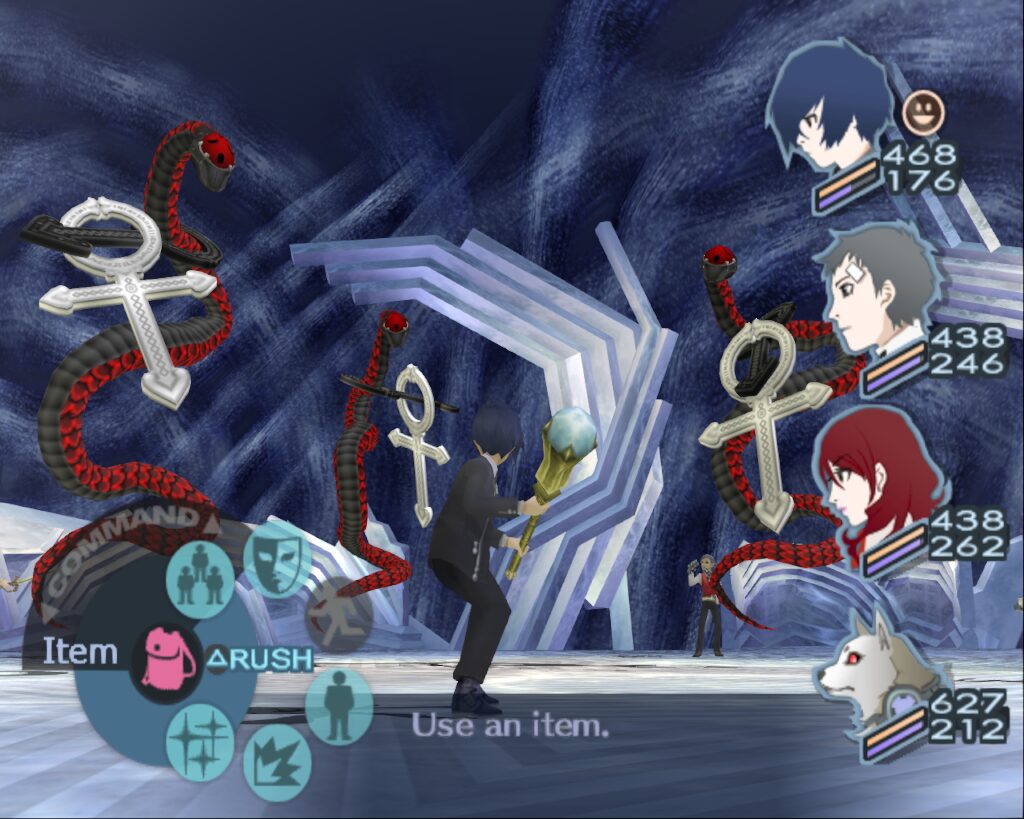
The monsters you find here are surreal creatures, typically black blobs with a mask glued to a random object. There’s a stag beetle with the purple mask at the end of its horn. There is a tiger’s head grafted onto a spiked chariot wheel. There are floating snakes that coils around themselves in an unnerving fashion.
After a few fights with these abstract abominations, I had a revelation: Persona 3 has almost everything I want from a turn-based battle system.
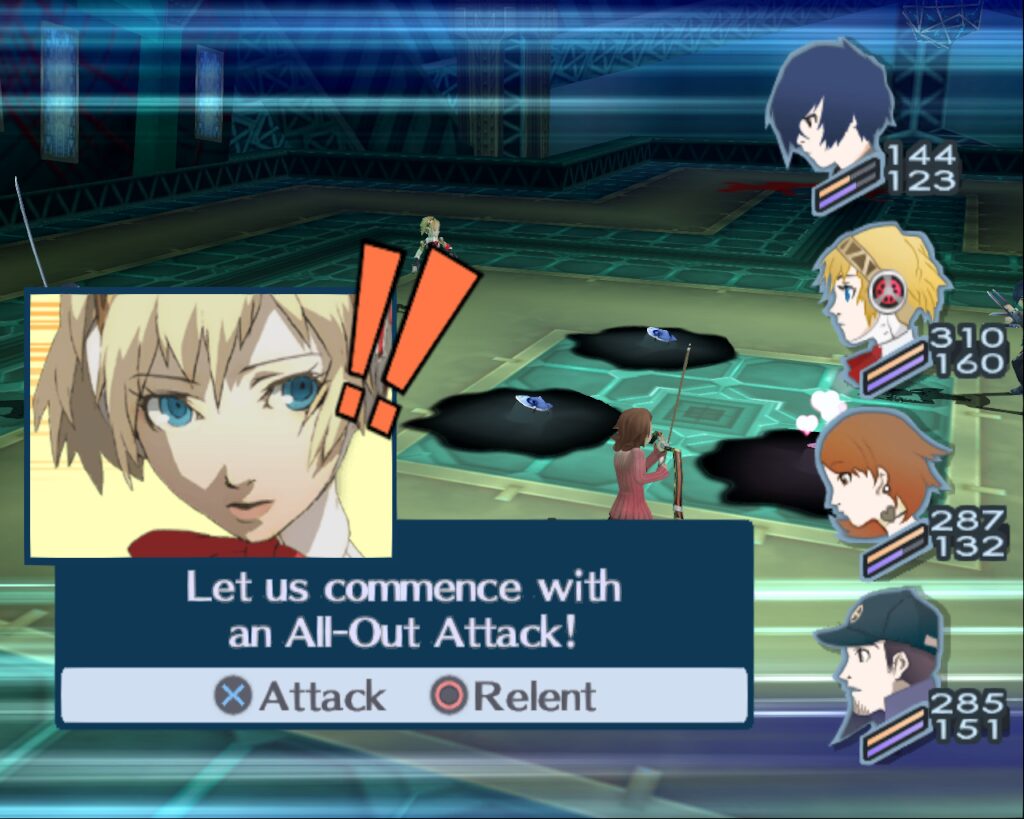
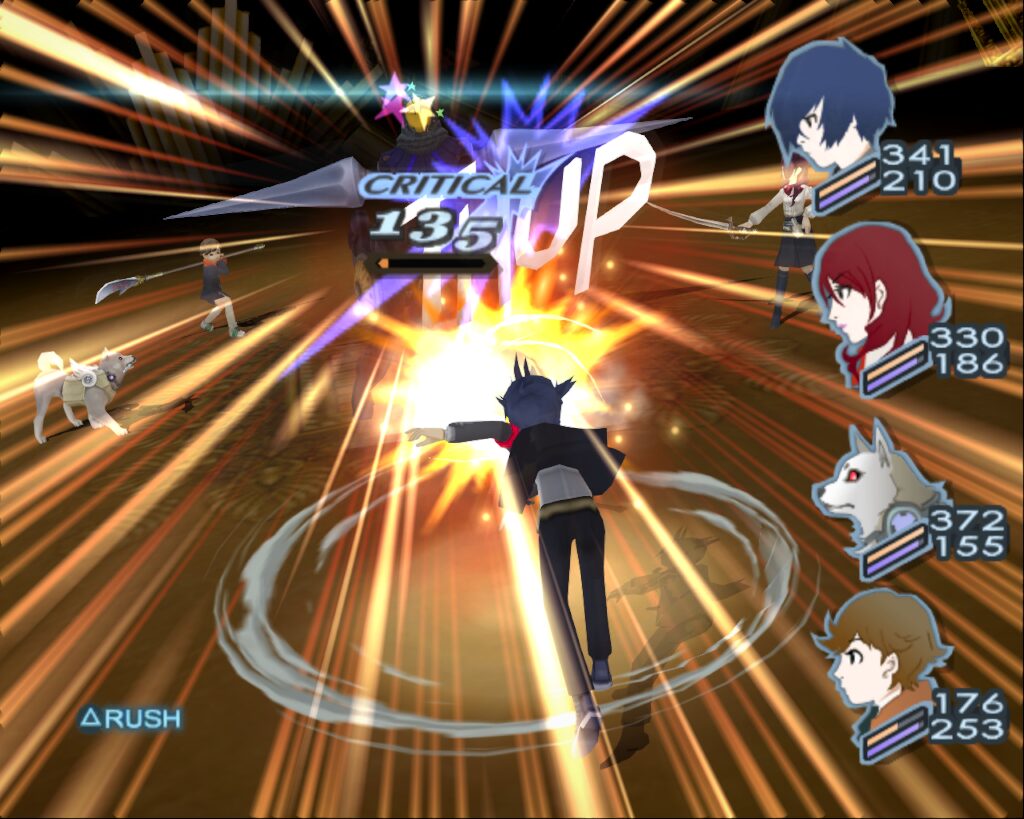
How often do you choose Attack in a JRPG because you can’t think of anything better to do? That’s not how it is here. For one, the reward for hitting an enemy’s weakness is just too juicy to ignore. Not only do you get an extra turn for knocking them to the floor, but if you can do that to all foes you can perform an “all-out attack”, usually ending the battle It is very like watching a row of monster-shaped dominos fall in slow motion.
This makes having a range of magic essential, and a range of physical attacks too, but it goes beyond that, because eventually you find enemies without weaknesses, or enemies that hit so hard that they will still kill you before you kill them. How do you deal with those? Buffs, defuffs, status ailments and elemental resistances become the counters that you can’t get with elemental attacks alone.
Almost every move in your menu has a purpose, and almost every turn makes a difference.
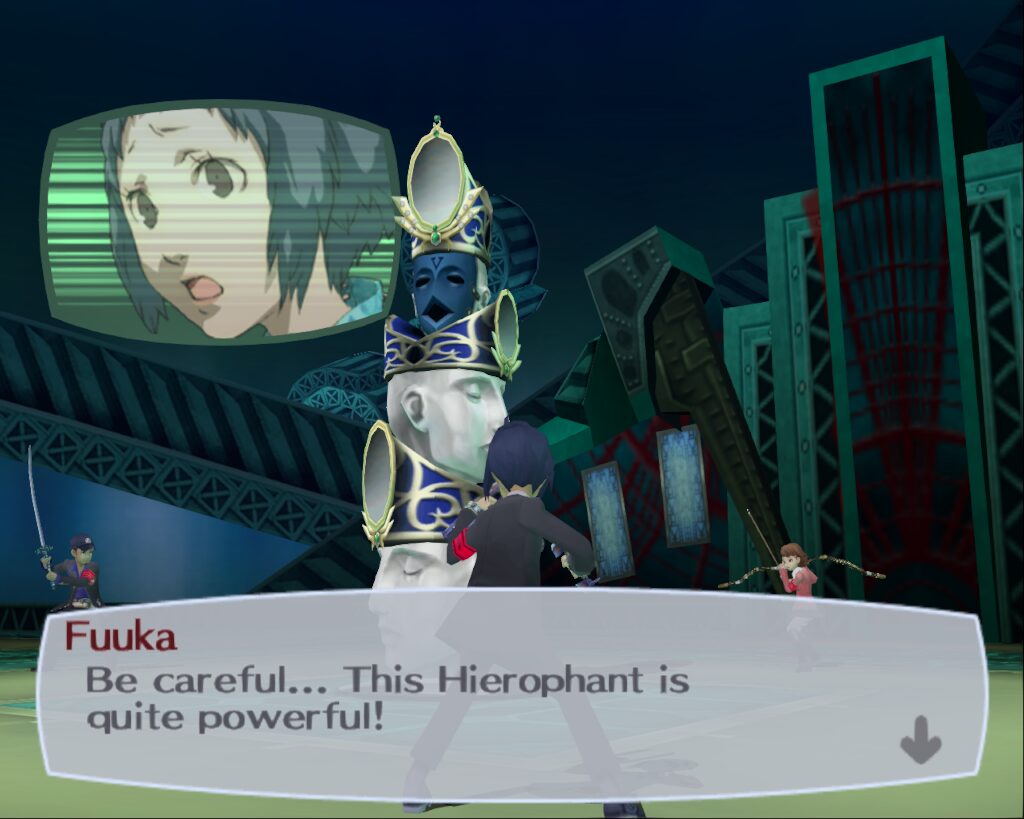
Persona 3 is a game of counters, hard counters even, and they’re not always obvious. Sometimes the solution you need is found in an item, such as the a magic mirror that reflects magic, versus the magic bomb dropping Sleeping Table mini-boss). Other times, the trick involves a sequence that you repeat throughout the battle. Bosses can be discouragingly brutal until you find the right approach, but when you do it’s like activating a cheat code.
This results in battles where every correctly chosen attack feels powerful and every major success feels earned. I think back on how easy it is, in other JRPGs, to ignore the attributes of battle, and how flat and redundant those systems seem now.
Oh, and because these battles involve a variety of hard counter, it really does incentive you – well, force you – to change your personas, weapons and party members according to the situation. And I love the variety that arises from that.
Persona 3 is long, maybe repetitive, but almost to the end I was still making mistakes and learning new ways to succeed.
A critical hit in battle of Persona 3
Field
The field is what connects your exploration experience to your battling experience. In Persona 3, it means the halls of Tartarus, in which you can enjoy a highly developed “field-game” that exceeds that of most other JRPGs.
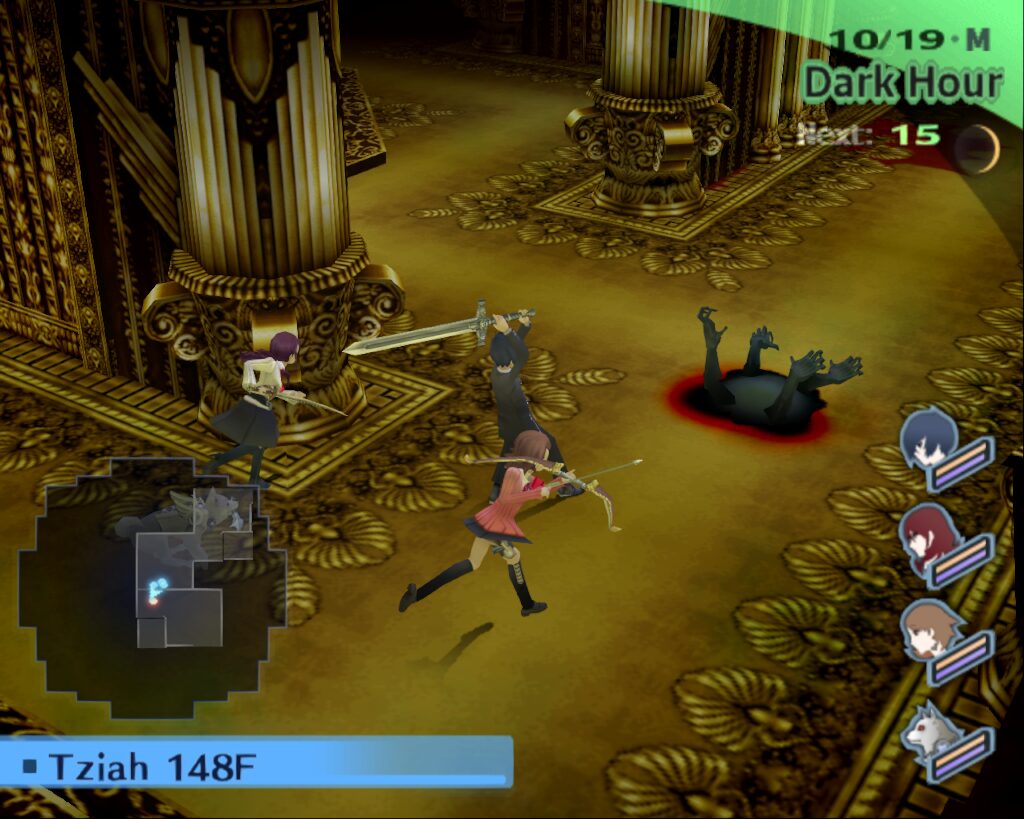
It is reminiscent of Earthbound, but better. Enemies, visible in the halls as a slimy blob, will chase you, but they can always be avoided. The size of the blob indicates the number of enemies, but not their strength. A large blog is likely a group of weak enemies. Counterintuitively, it is the small blobs you should watch out for, but not as much as the red blobs, which represent truly threatening battles.
There is an even greater threat than that to be found, too: if you stay on a floor too long, the grim reaper shows up! On the other hand, if you out level a group of enemies to the point that the encounter would be trivial, they will run away from you.
Hit a foe before they hit you to get a better chance at a first turn advantage. Let them hit you first, and it’s probably going to hurt. Swinging your sword (or spear, axe or fist) in the dungeon screens feels surprisingly nice. It never got old to surprise an enemy by dropping the end of my sword down their back.
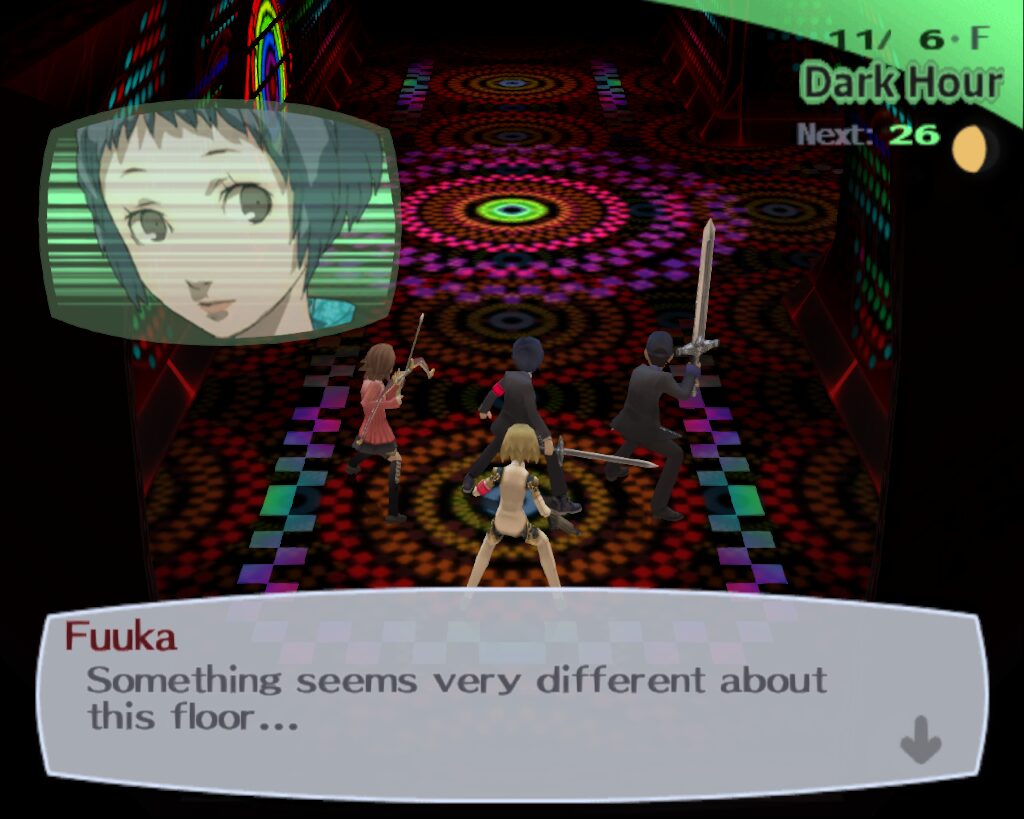
Here’s an example of those systems in action. This happened while I was climbing from floor 90 or so. I was ready to retreat at around floor 93 but I couldn’t for the life of me find a teleporter. So I kept climbing, avoiding battles where possible, but also hitting enemies first if I otherwise risked the enemy hitting me. If they got the initiative I was confident they would could wipe me out, so I removed enemies from the field where I thought it was prudent. The red enemies scared me of most of all. On floor 97, Fuka told me the teleporter was on the next floor. Then, a red enemy appeared just a few steps from the room with the stairs! I snuck around him, and punched the air as I reached safety.
This is a lot more positivity than you might expect of a discussion around Tartarus. While the systems here are excellent, the level design is generic: randomly generated floors of a single dungeon, with a different tile set every 30 or 50 floors, but functionally almost identical from the first floor to the last.
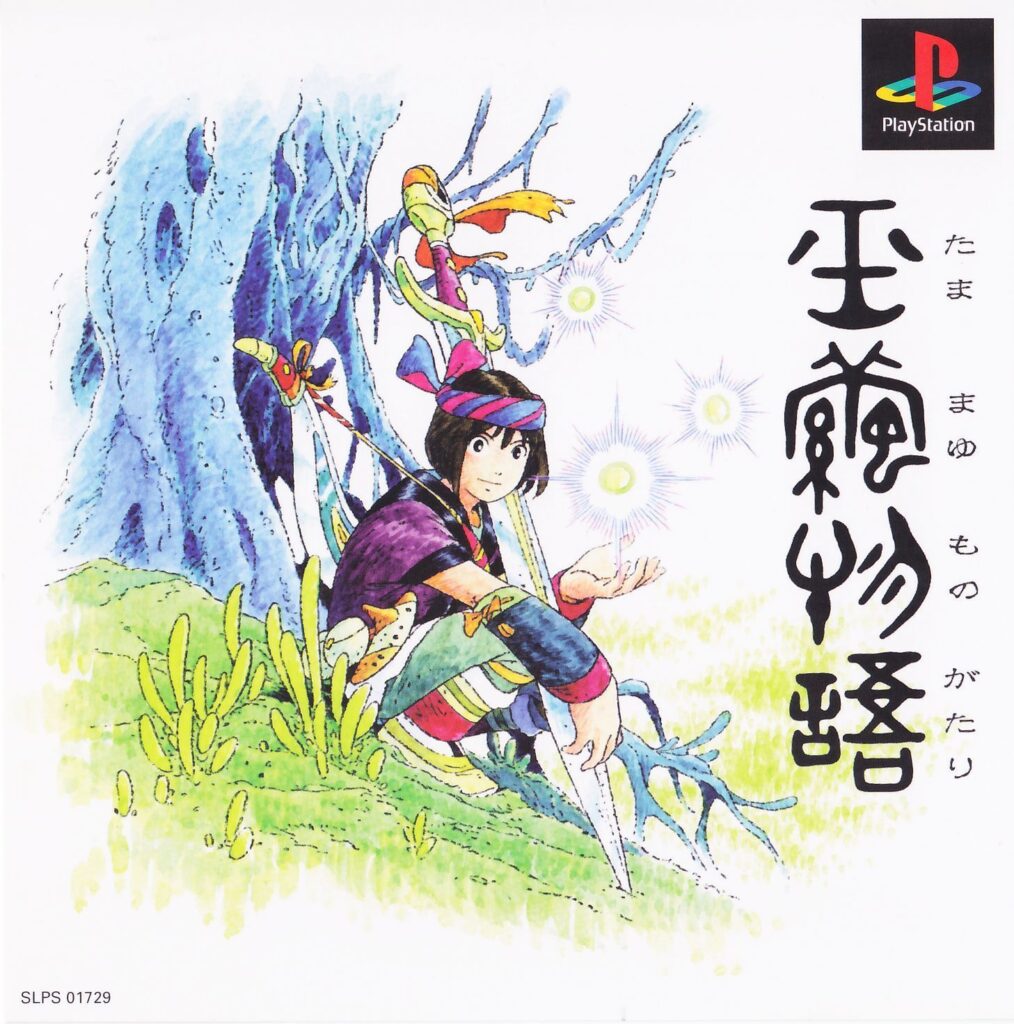
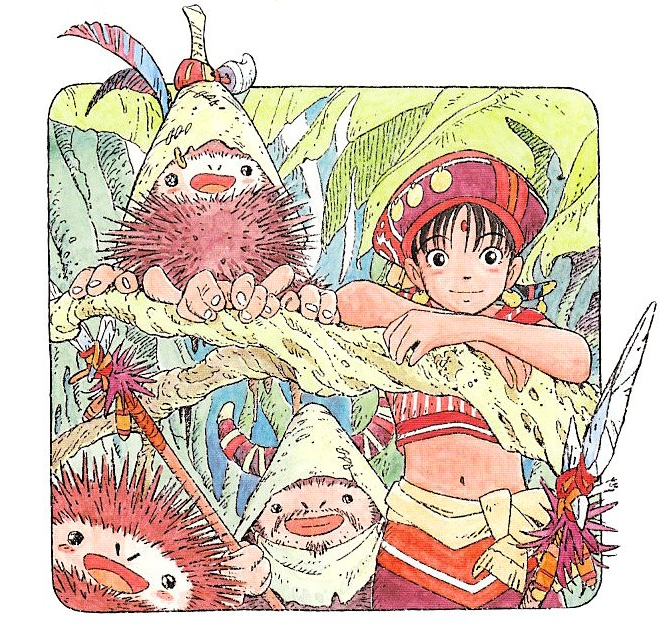
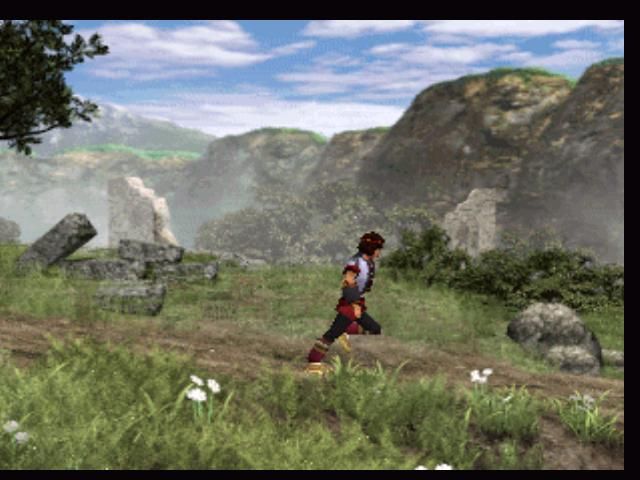
It’s hard not to think about Jade Cocoon at this point (What is Jade Cocoon?). The first game had forests that were everything I wanted from JRPG levels, with something visually interesting on every screen and with many-non combat interactions with NPCs and the environment. In Jade Cocoon 2, released on the PS2 but pre-dating Persona 3 by about 5 years, the forests had become repetitive, endless identical paths resembling Tartarus’s endless identical corridors. But in Jade Cocoon 2, there were still, rarely, NPCs to speak to.
Persona 3’s dungeon is fantastic for facilitating combat encounters, but it fails at integrating into the narrative or into the world in a moment-to-moment, floor-to-floor manner (the dungeon does have a broader purpose in the story, of course).
But because you can run from enemies, and because it’s not too rare to get lucky and find the stairs leading upwards right next to where you arrived, and because you can choose when to enter the dungeon (ignoring it for many days in a row in favour of the social sim mechanics), the game doesn’t force you into engaging with its tedious level design too often. It is easy for me to overlook this flaw.
Moreover, little pleasures like figuring out the weaknesses of new monsters you encounter, or seeing higher numbers on the minor arcana cards you pick as a reward at the end of some battles, helped keep the climb engaging.
Levelling
As a gun should feel good to shoot in a FPS, so too should a level-up feel good to achieve in a JRPG. But not all level-ups are created equal. When reflecting on RPGs, I often ask myself, did I care about getting those next levels?
In Persona 3, the answer is “Extremely yes!” New main character levels do something much more significant than small stats boost: they let you fuse personas up to your new level. Every time, it excited me to get back to the velvet room to explore what powerful monsters I might be able to add to my arsenal next.
Seeing the silhouettes of monsters that are beyond your current level in the fusion screens gives you a tantalising hint at what will be possible in a few levels time, or sometimes much later.
Also, the music that kicks in on the victory screen when you level up pumps me up.
The interesting decisions you make as you get stronger are just dramatically higher than any other JRPG I have played:
Resistances and weaknesses matter massively, so you probably look at those first when fusing a new monster.
You still need to out-stat the opponent, so you check which option improves your attack and defence the most.
Then, does the new monster have abilities that are going to make you more deadly, or can they inherit good abilities from your current monsters?
And at all times you team needs to be fairly balanced, dealing damage and defending damage against as many of the types as possible.
This is nothing like Pokemon, where you can get comfortable with a team that you like and just keep them levelled up. No, you are always having to reinvent your team in Persona, and you better do it the right way because these battles won’t let you get away with much less.
There is equipment for your characters, but compared to the monster fusion this is a uninteresting element of getting stronger. In most games, finding or buying some a new weapon or amor piece is a big part of the fun. In Persona 3, everything else is so fun I almost wanted to ignore the equipment.
Getting stronger together
We’ve explored the entire process of getting stronger in Persona 3, and what stands out to me most of all is how social links marry the story and the levelling together so beautifully.
You spend half of this game with people that don’t know that demons exist. Your daytime life does not resemble the time your spend in Tartarus at all. Superficially, they are two separate games.
And yet, the the contribution of these people to your strength and your success in battle is palpable at all levels of the game.
When you spend time with them, you level up their arcana. When you fuse a monster, you are grateful to that character for the additional experience you receive. Then you take that monster into battle.
I imagine the anime protagonist who receives the thoughts and prayers of their friends they made throughout the show to level up their attack to beat a boss. That’s what Persona does, but not just as a narrative trope, but as a mechanic.
It is that this, of all the great accomplishments of Persona 3, from the visual flair to the soundtrack to the battle system, that is most impressive to me.
Legacy
A lot of people think of Persona 3 as the lesser sibling of Persona 4 or 5, which is horrendously unfair. Not only because Persona 3 has its unique qualities, but also because it was the first.
Today, we recognise that Persona 5 as a masterpiece that has drawn new fans in to the franchise and into JRPGs as a whole. Yet it builts firmly on the foundations of Persona 3. You can’t say the same thing about Persona 3 and Persona 2, at least not to the same degree. A tremendous creative leap was made by this franchise in 2006, and it was a leap not only for Persona, but for all JRPGs.
Persona 3 popularised the combination of social sim and a dungeon crawler. Post-persona, we see more games making a mechanical connection between character relationships and battle effectiveness: Fire Emblem already had a support system and character conversations at the base, but post-Persona they were combined into a system that effectively mirrored social links.
We can see influences, subtle and otherwise, across the genre. I don’t think Trails of Cold Steel or Final Fantasy Type-0 exist without Persona 3. Frankly, with the way Persona 3 reinvigorated Atlus, there might not even have been a Shin Megami Tensei 4.
Both Atlus and fans of Atlus games owe Persona 3 some gratitude. It might secretly be one of the most influential JRPGs ever. It deserves to be in the same conversations as Final Fantasy VII. It will remain a blueprint for any designer wanting to combine two genres and them both to tell one story with one strong theme.
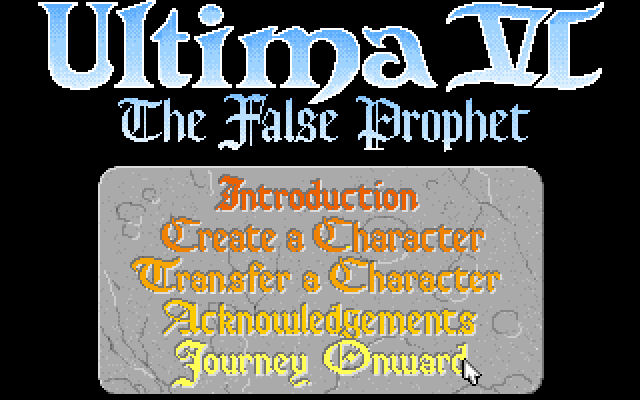
Ultima VI: The False Prophet, released in 1990, remains a timeless classic that continues to be enjoyed in 2023 (and beyond).
Though the last in a loose trilogy of Ultima games (4, 5 and 6), Ultima VI is easy to recommend as an entry point for players new to the series. Developed for the IBM PC and with the luxury of 256 colour VGA graphics, the visual jump from the earlier Apple II-developed games is drastic. Also, Ultima VI removes the first-person dungeons and two-scale maps and instead presents one coherent, consistent world, making it much more palatable to modern players.
However, as is to be expected of a game that is almost 35 years old, it can be inaccessible in some ways. This article aims to get you settled into the world of Brittania as painlessly as possible.
Tips for getting started
Some things that might be useful to know to make your first sojourn into this world more pleasant:
1. Play on Nuvie. Ultima VI ran on MS-DOS, which doesn’t exist on modern PCs, so when you download it from GOG or somewhere similar it will play in an emulator called DOSBOS.
However, there is a better solution, and that is to play Ultima VI through Nuvie, an engine for playing Ultima VI on modern systems. If you’re playing this classic CRPG in 2023, Nuvie will make your experience a lot smoother, without changing the game.
After these tips I’ll explain how to set up Nuvie, so skip to here if you’re ready to get started.
2. If you want your companions to help you in a scrape, switch to battle mode. Otherwise, they’ll just scratch their heads while you all get pelted with throwing axes. The keyboard shortcut is B. Sometimes they are shy about attacking, but you can fix that by changing their behaviour in their stats screen. Change to “Control” to manually command that character on their turns.
I put this one here because when you start the game you’re dropped straight into a battle.
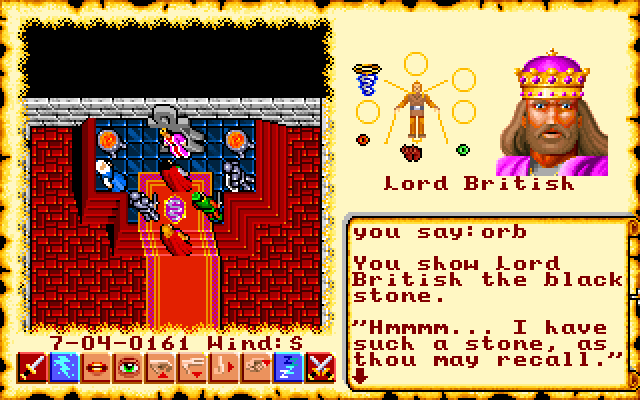
3. Answer the copy protection questions. When that battle is over, your first instinct will probably be to talk to the king you just saved. That’s Lord British. But he’s not very welcoming, insisting that you take a quiz before he will say anything useful to you. This is Ultima VI’s piracy protection. The answers were contained in the manual that came with legitimate copies of the game. If you bought your copy from GOG, you can download this “Compendium” digitally, which you should do anyway because it’s a beautiful booklet and delves into the lore of the game. However, for the sake of getting past Lord British’s questions, just find the answers on Ultima Codex, the main Ultima Wiki, here: https://wiki.ultimacodex.com/wiki/Ultima_VI_copy_protection
4. Find out what to do next by talking. You get information out of people by typing in keywords while talking to them. A good place to start is with the NPCs “name” and their “job”: this will usually lead to other key subjects, which will be highlighted in a different colour of text. This game will not make things easy for you if you aren’t listening to what people say and seeking more information by interrogating other people on the same subjects. Take notes, because the game won’t do that for you either. It’s pretty hands-off, in this regard and others.
On this topic, a good place to start your enquiries would be to ask Lord British about the orb you found in the game’s introduction. You’ll want to figure out how to use it to cut down on travel time in the game, but you might want to leave that until you understand the geography of the world a bit better.
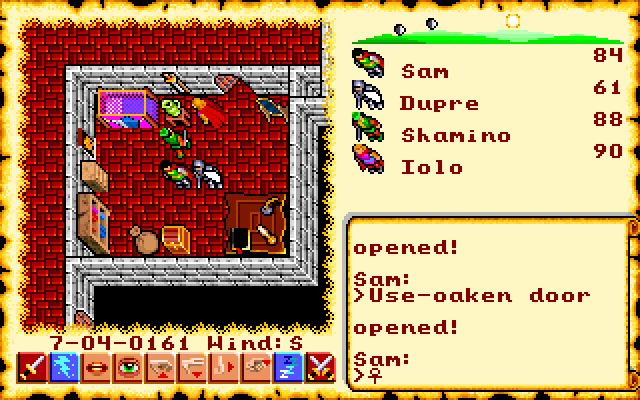
5. Controlling other characters and their inventories. The number keys switch control to other characters, also giving you access to their inventories, so you can carry more loot and keep it better organised. The avatar’s backpack will be full before you leave the castle, so knowing this immediately will save you some frustration. Press 0 to switch back to the default “party mode”.
6. Embrace the old-school interaction method.Ultima VI doesn’t have a context-sensitive button that allows you to do everything from pick up items, to talk to somebody, to open chests, to read a sign. In fact, these actions are all separate buttons (or keystrokes): get, talk, use, and look. When you choose your action, you then target something with it. It’s a bit of a habit change, but when you get used to it you see some advantages, like how you can talk to everyone in a bar without leaving your seat.
7. Learn these keyboard shortcuts. You can play this game entirely with the mouse but it’s quite a bit slower this way. I feel my clicking finger could get tired. Learning the keyboard shortcuts will make your adventure smoother. F1, F2 etc switch to the inventory of party members, and F10 brings up the full party screen with the time of day indicator. Crtl-1, Crtl-2 etc bring up stats screens.
Setting up Nuvie
Nuvie adds, among other many other things:
An in-game settings menu for audio, visual and gameplay tweaks
Enhanced and modernised controls like drag-and-drop for items
More comfortable default key bindings and the ability to customise key bindings
Overhaul of save/load system
Convenience features like automatically using keys on doors becoming
An option for a UI overhaul similar to the style of Ultima VII
Choose the official release binary for your operating system.
Step 2: Install Nuvie on your computer
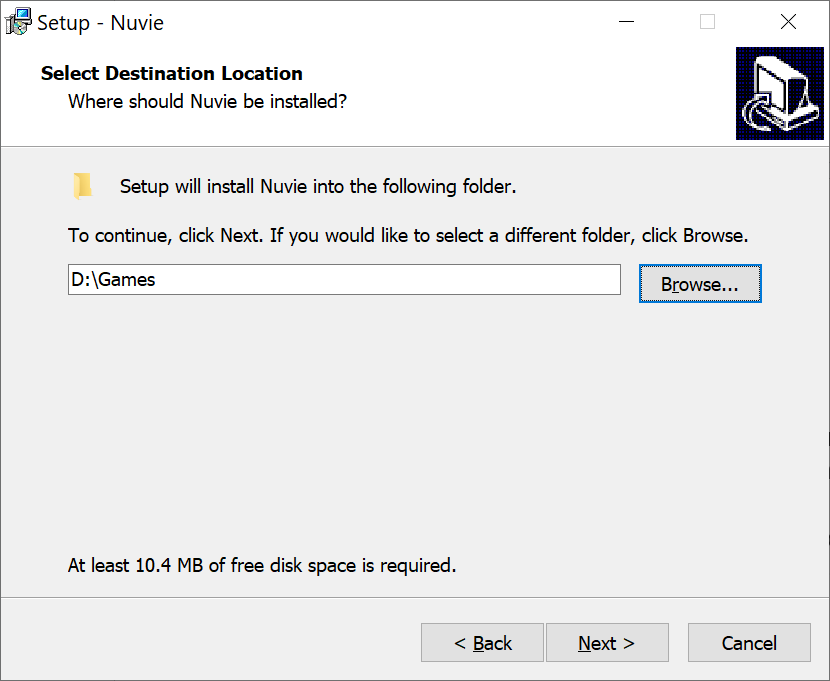
Install Nuvie anywhere you will find convenient. You can install it directly into your Ultima VI game folder, but the official documentation suggests you install Nuvie somewhere else and copy your Ultima VI game files into the Nuvie folder, which we will do next.
Step 3: Move Ultima 5 game files to the Nuvie folder
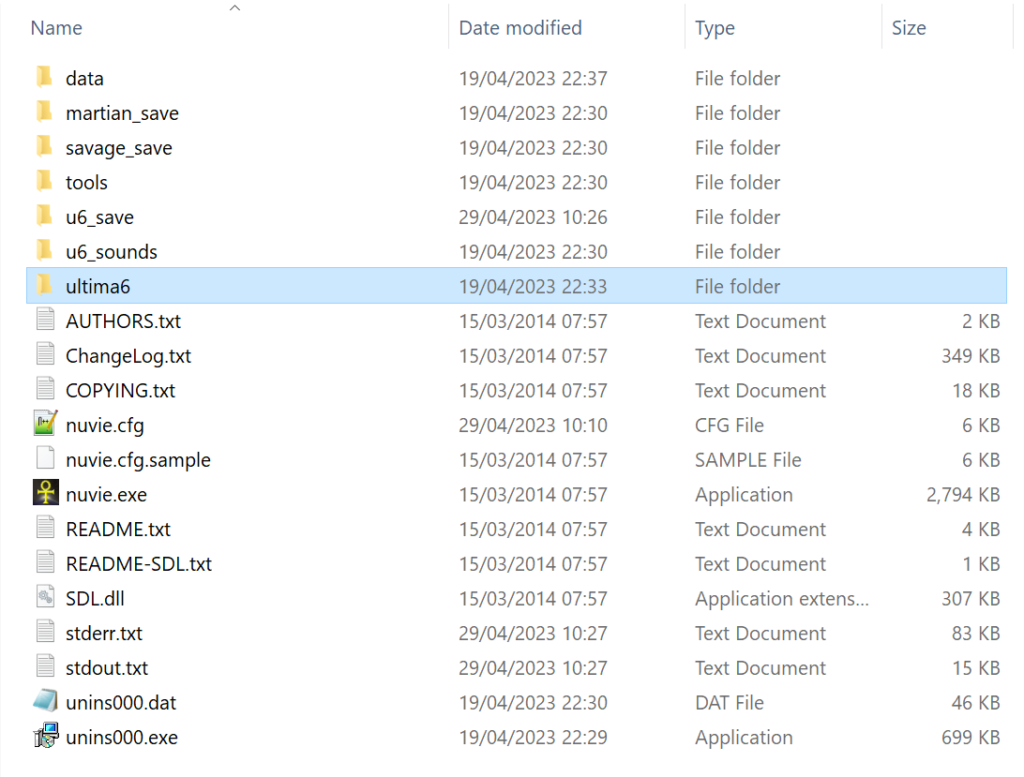
3.1 By default, Nuvie looks inside the Nuvie folder for a folder called ultima6, where it expects to find your Ultima VI game files. That folder doesn’t exist yet, so make it. Your Nuvie Folder should now look like this:
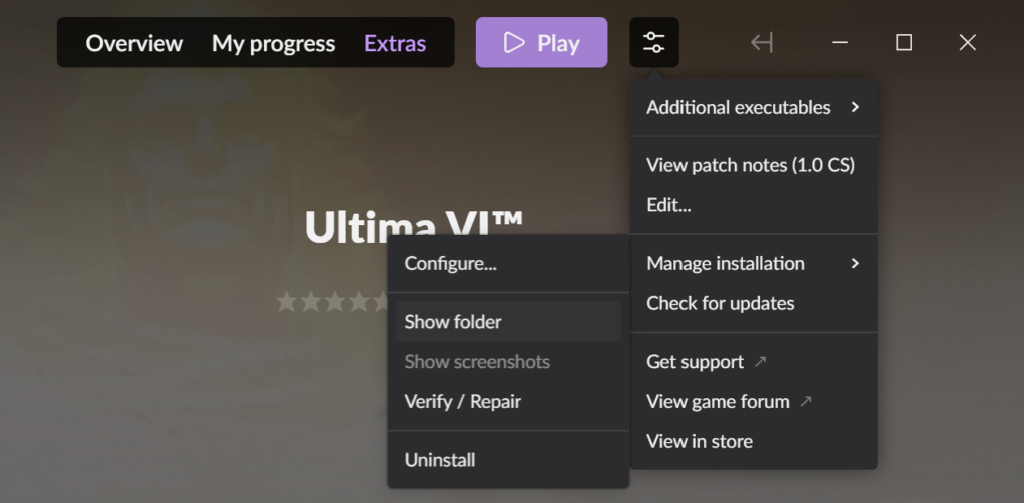
3.2 Find your Ultima VI game files, wherever you installed the game. If you have installed via GOG Galaxy, you can find the game files with this option in your game library:
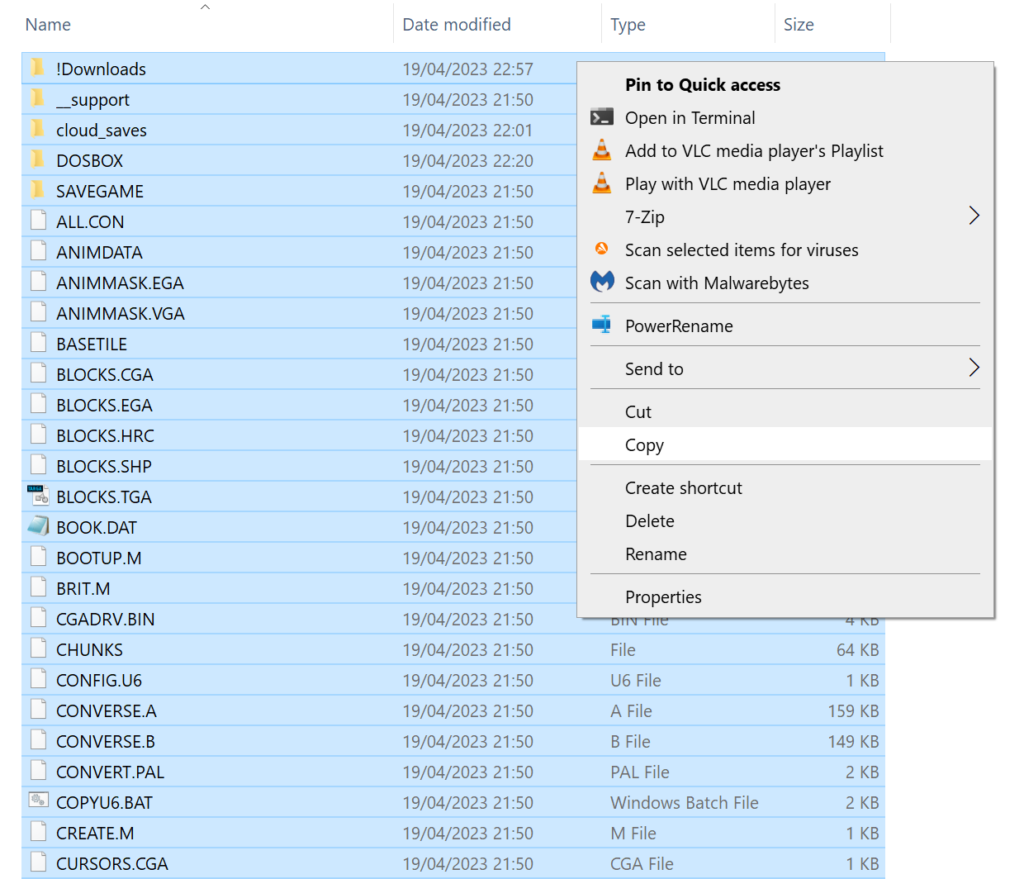
3.3 Copy all the game files…
3.4 …and paste them into the Nuvie ultima6 folder.
Step 4: Tweak the config file (if you want)
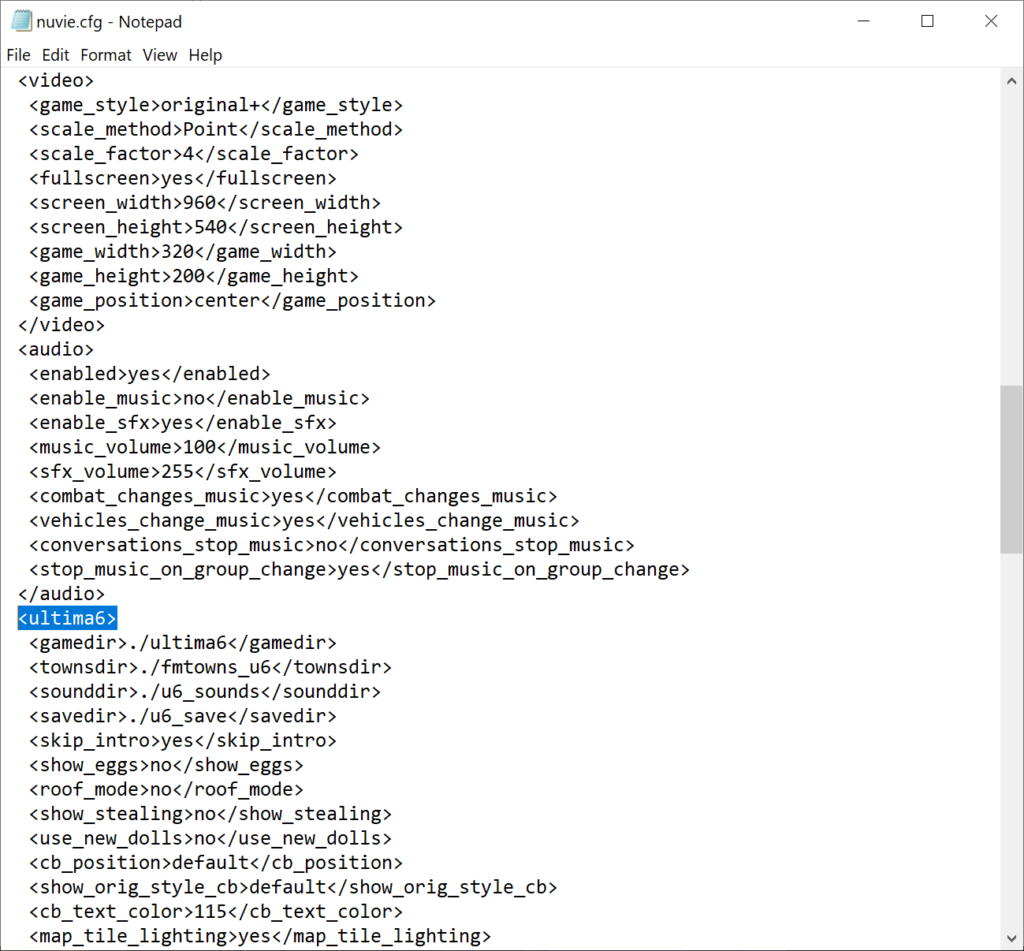
Some settings are changed by updating the text in nuvie.cfg, which is a file in your Nuvie installation folder. Most of the settings you will be interested in for playing Ultima are found in the <video> section (for general Nuvie display options) and in the <ultima6> section.
Even if you don’t make changes now, keep these settings in mind in case you want them later.
Everything you need to know to choose what game to start with
So, Final Fantasy has caught your interest. Who can blame you: with Final Fantasy 14, the MMORPG, outperforming World of Warcraft, and the hype for the single-player action-RPG Final Fantasy 16 at a high, it’s natural you are curious about this storied franchise.
But Final Fantasy is a weird franchise. It’s big and complex and has been around forever. In that time it has developed its own set of conventions that fans understand but aren’t always intuitive to new players.
In this article, we’re going to get you up to speed as painlessly as we can. We’re going to show you all the quirks that make this series special, then demystify them so you can pick your first Final Fantasy game and maybe fall in love with these games like we have.
If you want to skip the background info and know which game you should play first and why, click here.
Contents
Why play Final Fantasy
For over 35 years, the Final Fantasy series has been leading videogames in fully realised fantasy worlds, beautiful music and cutting-edge visuals. It has memorable characters that have become icons, and stories that deliver twists and emotions in equal amounts. And because it recreates itself with almost every instalment, it is a series that is almost impossible to get bored of.
Who plays Final Fantasy?
It is impossible to know how many fans the series has worldwide, but it is probably tens of millions. Here are a few numbers for illustration:
According to mmo-populations.com, Final Fantasy 14 has over 40 million players.
Probably the best-selling game in the franchise is Final Fantasy 7, the original PS1 and PC versions selling over 10 million copies.
For a more recent bestselling game, Final Fantasy 15 also sold over 10 million copies
The r/FinalFantasy subreddit has 400k subscribers
The Square Enix YouTube channel has 300k followers.
Reasons for Final Fantasy’s popularity
Games in the Final Fantasy series have regularly been trailblazers for more complex stories and more advanced graphical fidelity in video games. It found worldwide appeal because it helped introduce Western console players to Japanese RPGs.
The series is also known for its music and characters, which linger in people’s minds long after they have finished the game.
Moreover, as a long-running series that has released games consistently since 1987, this series has had a long time to build up a following.
What you need to know
A series of standalone games
The first thing to understand about the Final Fantasy series is that all of the major numbered [jump link] games exist in their own universe, with different characters and unconnected stories.
There are direct sequels in the franchise, such as Final Fantasy 10-2 (a sequel to Final Fantasy 10), but other than these rare cases you can play any major games in the series without having played any others. [optimse as answer tag]
Common elements of Final Fantasy
Or, How to spot Final Fantasy in the wild.
Though the games do not share stories or even worlds, there are themes, ideas, visuals and more that recur across the series and make a Final Fantasy feel like a Final Fantasy game.
Chocobos: Bird-like mounts, most commonly yellow. Introduced in Final Fantasy 2.
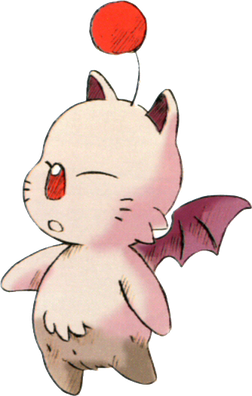
Moogles: A race of cute magical creatures with pom-poms on their head that say “Kupo!” They fill various roles across the series. Introduced in Final Fantasy 3.
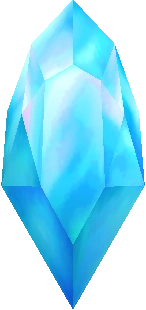
Crystals: Large magical crystals that play a role in the story, sometimes named after the four elements.
Monsters: Bombs, tonberries, cactuars, malboros and behemoths are some of the more iconic recurring foes, though there are many more.
Summons: Powerful creatures that can be called into battle, several of which appear in almost every game, including Shiva the ice queen, Ifrit the fire demon, and Bahamut the dragon. Introduced in Final Fantasy 3.
Jobs/Classes: Combat roles like black mage, white mage, red mage, dragoon and thief have associated design elements across the series. Introduced in Final Fantasy.
Spells: Mages across the series have pulled from a common pool of spells with shared naming conventions, where suffixes like “-ara” and “-aga” indicate more powerful versions of spells (eg. Blizzard, Blizzara, Blizzaga in order of power)
Equipment: Weapons like Masamune and Ultima Weapon are found in multiple games.
Music tracks: Though the games do not generally share music, there are a few exceptions that appear in many games, such as the chocobo theme. In particular, Prelude (or Crystal Theme) and Final Fantasy (or Main Theme) are in many games in the series.
The Roman numerals
Not everyone learns Roman numerals in school, and being a Star Wars fan will only take you up to IX = 9. This method of numbering can make distinguishing the major Final Fantasy games a bit of a challenge for new fans. For clarity, in this article we’ve named the games with Arabic numbers, but here are all the titles in both formats:
Title (Roman Numerals)
Title (Arabic Numerals)
Final Fantasy
Final Fantasy 1
Final Fantasy II
Final Fantasy 2
Final Fantasy III
Final Fantasy 3
Final Fantasy IV
Final Fantasy 4
Final Fantasy V
Final Fantasy 5
Final Fantasy VI
Final Fantasy 6
Final Fantasy VII
Final Fantasy 7
Final Fantasy VIII
Final Fantasy 8
Final Fantasy IX
Final Fantasy 9
Final Fantasy X
Final Fantasy 10
Final Fantasy XI
Final Fantasy 11
Final Fantasy XII
Final Fantasy 12
Final Fantasy XIII
Final Fantasy 13
Final Fantasy XIV
Final Fantasy 14
Final Fantasy XV
Final Fantasy 15
Final Fantasy XVI
Final Fantasy 16
Start with these games
We’re going to get into the weeds on this in a minute, and when you’ve read the next few sections you should feel more confident picking a first game for yourself, if you want.
However, to give you the quick answers:
We think, for the average person, the best starting point is Final Fantasy 10. It is an extremely popular and accessible starting point, a gripping story, and hits the perfect balance of experimenting with the formula while being true to the series’ identity.
In some ways, Final Fantasy 4 is where the series “became itself”, and features all of the hallmarks seen in the rest of the series. A great place to start if you want a historical perspective but don’t want to go all the way back to Final Fantasy 1 (which you might consider archaic).
Final Fantasy 7 is the first 3D game, so a good place to start if you don’t want to play something 2D, and absolutely a historical landmark mark not only for the series, but for Japanese gaming in the West, JRPGs, and gaming as a whole. Don’t miss it.
Final Fantasy 14 is an MMO, so is not the “standard” Final Fantasy experience, but it is extremely good. Plus, being an absolutely dominant force in the MMO market, it is probably the most popular introduction to the series these days. It also looks a lot more modern than the other starting points mentioned here.
A brief history of the series
The first eleven mainline games were all developed and published by Square.
Final Fantasy 1 to Final Fantasy 6 are 2D games released first on Nintendo hardware. 1-3 were originally released on the Famicom (NES), and 4-6 originally released on the Super Famicom (SNES).
Only Final Fantasy 1, 4 and 6 were released in the US, and 4 and 6 were renumbered as 2 and 3. So if you ever hear somebody refer to Final Fantasy 6 as Final Fantasy 3, this is the reason. It also means that Final Fantasy 2, 3, and 5 were not originally released in the West and so fewer older fans have the same connection with those games that they do for the others.
After this, Square moved the franchise from Nintendo systems to Sony systems, partly as a result of the Playstation using disks over cartridges.
Final Fantasy 7 to Final Fantasy 10 use 3D graphics and were released first on Playstation consoles. 7-9 were released originally on the PS1, and 10 on the PS2.
Though many of the games in this era are beloved bestsellers, the most successful one up to this point was undoubtedly Final Fantasy 7, which was often held up as one of the best videogames, or one of the best videogame stories, ever made.
Final Fantasy Tactics for the PS1 was the most significant spin-off released during this period.
All of the mainline games up to this point were traditional, turn-based JRPGs. After Final Fantasy 10, each game mixed up the formula more than ever before.
Final Fantasy 11 was the first MMORPG of the series and was followed by many expansions.
The first movie in the franchise, Final Fantasy: The Spirits Within, was released in 2001. Its inability to recoup its costs became a pivotal moment not only for the franchise but for Square as a company.
Financial difficulties was one reason Square merged with Enix to create Square Enix. Exix were the publisher of the Dragon Quest games, Final Fantasy’s main competitor in the JRPG market.
In the years following the merger, some changes in the series can be identified.
Starting with Final Fantasy 10-2, sequels and prequels to the stories of mainline games became a regular part of the franchise. Sub-series were made to expand the worlds of mainline games, including Compilation of Final Fantasy 7 (new games in the world of Final Fantasy 7) and Ivalice Alliance (new games in the world of Final Fantasy Tactics). New mainline games, starting with 13, were introduced as multi-game or multimedia projects, subseries in their own right.
After 10, each mainline game would reinvent the formula, resulting in games that are more diverse than ever before, being separate not only in their story but also in their mechanics. Final Fantasy 12 removed battle screens and took inspiration from MMOs, whereas 13 brought back battle screens but entirely overhauled ATB and class systems from older games to make something unique.
Final Fantasy 14 was a second MMO that was a critical and commercial failure but was relaunched as Final Fantasy 14: A Realm Reborn and became a massive success.
Final Fantasy 15 was the first mainline game to feature action combat. This direction continued with Final Fantasy 7 Remake and Final Fantasy 16.
And that pretty much gets us up to date!
But that only covers the mainline series. By our count, there are about 100 original Final Fantasy games.
How many games?!
Yep, there are about 100 original Final Fantasy games! It depends on how you count them though. To get this number, we didn’t include ports, compilations or remasters, but did include spin-offs, remakes, and smaller games that are not full-scale JRPGs. [optimse as answer tag]
A few games are in a grey area, such as the Pixel Remasters, that look and play differently than the original games. However, we still choose not to include it in our count. We did include the remakes of Final Fantasy 1 and 2 for the Playstation compilation, as we considered them to have passed a threshold to be counted as new games, and full remakes such as Final Fantasy 3 for the DS and Final Fantasy 7: Remake are also considered by us to be new games.
However you choose to count them, there are rather a lot of games in this series. Let’s try and make a little more sense of these.
Mainline series
There are 15 mainline Final Fantasy games. When fans talk about the mainline series, they mean the games that count up in ascending order from the original game: Final Fantasy, Final Fantasy 2, Final Fantasy 3, and so on. The latest was Final Fantasy 15, which gives us 15 games.
This excludes games like Final Fantasy Tactics and Final Fantasy: Crystal Chronicles, which are considered spin-offs. More about them in a minute.
What makes mainline games special is that they introduce new worlds and characters, and tend to have the largest budgets (and sales) of any other Final Fantasy project of its time. They tend to be the games that push the series forward the most.
Eventually, direct sequels to the mainline games were produced, leading to games with titles such as “Final Fantasy 10-2”. These are also sometimes considered part of the mainline series, but not always. Take Dirge of Cerberus, a third-person shooter that continues the story of the mainline game, Final Fantasy 7. It has very different gameplay from the original game, so people are comfortable calling it a spin-off. We will list the sequels separately.
As you can see, it is down to some interpretation. But here’s a fairly typical list of which games are considered the “mainline Final Fantasy games”:
Title
Release Date
Final Fantasy I
1987 Dec
Final Fantasy II
1988 Dec
Final Fantasy III
1990 Apr
Final Fantasy IV
1991 Nov
Final Fantasy V
1992 Dec
Final Fantasy VI
1994 Apr
Final Fantasy VII
1997 Jan
Final Fantasy VIII
1999 Feb
Final Fantasy IX
2000 Jul
Final Fantasy X
2001 Jul
Final Fantasy XI
2002 May
Final Fantasy XII
2006 Mar
Final Fantasy XIII
2009 Dec
Final Fantasy XIV
2010 Sep
Final Fantasy XIV: A Realm Reborn
2013 Aug
Final Fantasy XV
2016 Nov
Final Fantasy VII
2020 Apr
Final Fantasy XIV
2021 Dec
Final Fantasy XVI
2023 Aug
Sequels and prequels
The Final Fantasy franchise resisted sequels for a long time, choosing to create new worlds with new characters with each new game. This changed with Final Fantasy 10-2, which reused the assets of Final Fantasy 10 to tell a sequel to that story.
Since then, stories that spin off from mainlines titles have become a common element of the franchise, and some games have even been announced as multiple-game series from the start. We have also included expansions to the MMO games.
Title
Type
Release Date
Final Fantasy X-2
Sequel
2003 Mar
Final Fantasy XI: Rise of the Zilart
Expansion
2003 Apr
Final Fantasy XI: Chains of Promathia
Expansion
2004 Sep
Before Crisis: Final Fantasy VII
Prequel
2004 Sep
Dirge of Cerberus: Final Fantasy VII
Prequel
2006 Jan
Final Fantasy XI: Treasures of Aht Urhgan
Expansion
2006 Apr
Final Fantasy XII: Revenant Wings
Sequel
2007 Apr
Crisis Core: Final Fantasy VII
Prequel
2007 Sep
Final Fantasy XI: Wings of the Goddess
Expansion
2007 Nov
Final Fantasy IV The After Years
Sequel
2008 Feb
Final Fantasy XIII-2
Sequel
2011 Dec
Final Fantasy XI: Seekers of Adoulin
Expansion
2013 Mar
Lightning Returns: Final Fantasy XIII
Sequel
2013 Nov
Final Fantasy XIV: Heavensward
Expansion
2015 Jun
Final Fantasy XIV: Stormblood
Expansion
2017 Jun
Final Fantasy XIV: Shadowbringers
Expansion
2019 Jul
Final Fantasy VII: The First Soldier
Prequel
2021 Nov
Final Fantasy XIV: Endwalker
Expansion
2021 Dec
Remakes
Final Fantasy games are regularly ported and remastered for new systems, but sometimes the franchise goes a step further with full remakes that substaintially change the visuals and mechanics.
Title
Platform
Release Date
Final Fantasy I
WonderSwan Color
2000 Dec
Final Fantasy II
WonderSwan Color
2001 May
Final Fantasy III
Nintendo DS
2006 Aug
Final Fantasy IV
Nintendo DS
2007 Dec
Final Fantasy VII Remake
PlayStation 4
2020 Apr
Final Fantasy VII: Rebirth
Playstation 5
2023 Dec
Sub-series
There are a few groups of games that were given unique branding to distinguish them as their own sub-series. This extended beyond videogames, as these subseries also included films and short stories, such as the second movie in the franchise, Final Fantasy 7: Advent Children.
Compilation of Final Fantasy 7
Ivalice Alliance
Fabula Nova Crystallis
Spinoffs
All games with Final Fantasy in the title that are not considered mainline titles (subject to interpretation) are spin-offs.
Some spin-offs become Final Fantasy sub-series, or even entirely new series without the Final Fantasy name.
The first spin-off was The Final Fantasy Adventure, which is also a great example of a spin-off that became a new series. It was known as Seiken Densetsu: Final Fantasy Gaiden in Japan, but for the next game dropped the Final Fantasy moniker and became the Seiken Densetsu series, which in the West was called the Mana series. The first game using the Mana title was Seiken Densetsu 2, or Secret of Mana.
Another notable early spin-off was Final Fantasy Mystic Quest, which is best remembered as an attempt to make an RPG that was accessible to new players, but ended up disappointing Final Fantasy fans for being easy and shallow.
Like Mystic Quest, most spin-offs keep the Final Fantasy branding, even if they become their own series. Final Fantasy Crystal Chronicles, for example, was conceived as a Final Fantasy game with a co-op focus. It spawned sequels, each with its own subtitle, leading to games with long names like Final Fantasy Crystal Chronicles: Ring of Fates.
The following tables is dedicated to spin-offs that feature original characters. For the spin-offs that focus on the heroes introduced in mainline games, look at the crossovers section below.
Here are the major Final Fantasy spin-offs:
Name
Release Date
Final Fantasy Adventure (Final Fantasy Gaiden)
1991 Jun
Final Fantasy Mystic Quest
1992 Oct
Final Fantasy Tactics
1997 Jun
Final Fantasy Tactics Advance
2003 Feb
Final Fantasy Crystal Chronicles
2003 Aug
Final Fantasy Tactics A2: Grimoire of the Rift
2007 Jun
Final Fantasy Crystal Chronicles: Ring of Fates
2007 Aug
Final Fantasy Crystal Chronicles: My Life as a King
2008 Mar
Final Fantasy Crystal Chronicles: Echoes of Time
2009 Jan
Final Fantasy Crystal Chronicles: My Life as a Darklord
2009 Jun
Final Fantasy: The 4 Heroes of Light
2009 Oct
Final Fantasy Crystal Chronicles: The Crystal Bearers
2009 Nov
Final Fantasy Dimensions
2010 Sep
Final Fantasy Type-0
2011 Oct
Final Fantasy Tactics S
2013 May
Final Fantasy Explorers
2014 Dec
Mobius Final Fantasy
2015 Jun
Final Fantasy: Brave Exvius
2015 Oct
World of Final Fantasy
2016 Oct
Final Fantasy Awakening
2016 Dec
Final Fantasy Dimensions II
2017 Nov
War of the Visions: Final Fantasy Brave Exvius
2019 Nov
Final Fantasy VII: The First Soldier
2021 Nov
Stranger of Paradise: Final Fantasy Origin
2022 Mar
Crossover Spinoffs
Perhaps inspired by the success of crossover games like Super Smash Bros, Square Enix created the fighting game Dissidia. It was the first time existing characters from mainline games had come together to share a story.
Since then, Final Fantasy crossover games have been released regularly. This category includes Theatrhythm, a series of rhythm games that use Final Fantasy music, as well as a number of gatcha games where players summon characters from across the franchise.
Name
Release Date
Dissidia Final Fantasy
2008 Dec
Dissidia 012 Final Fantasy
2011 Mar
Theatrhythm Final Fantasy
2012 Feb
Final Fantasy Artniks
2012 Nov
Final Fantasy: All the Bravest
2013 Jan
Pictlogica Final Fantasy
2013 Oct
Theatrhythm Final Fantasy: Curtain Call
2014 Apr
Final Fantasy Record Keeper
2014 Sep
Dissidia Final Fantasy NT
2015 Nov
Dissidia Final Fantasy Omnia
2018 Jan
Theatrhythm Final Fantasy: All-Star Carnival
2016 Sep
Theatrhythm Final Bar Line
2023 Feb
Spinoff Series
As you can see, some spin-offs have sequels and become their own subseries. Here are the major spin-off series along with the number of titles that have been released in those
Series
Numbers of Games
Crystal Chronicles
6
Dissidia
4
Tactics
4
Theatrhythm
4
Dimensions
2
Brave Exvius
2
Which are the best Final Fantasy games?
That’s an excellent question, and a really tricky one. Every game is somebody’s favourite. Plus, different games rise and fall in popularity over time. But we’re here to give answers. If there were only 10 gold stars to give out to games in this franchise, we might suggest a list that looks like this:
Final Fantasy 4
Final Fantasy 5
Final Fantasy 6
Final Fantasy Tactics
Final Fantasy 7
Final Fantasy 8
Final Fantasy 9
Final Fantasy 10
Crisis Core: Final Fantasy 7
Final Fantasy 14
With this list, we are trying to distil the impossible-to-measure “common feeling” about the game among fans, based on informal conversions in fan communities as well as public surveys. You might say we are trying to emulate a popularity contest.
“The classics” have a lot of weight in this sort of list. Though Final Fantasy 4 and 5 are both important and beloved, a new player might find them less compelling than more modern games in the series.
Nonetheless, this list gives a great selection of games to play if you want to understand what the franchise is about and what makes it great. It tells you what the best the franchise has had to offer over time.
This does not mean that the games not on this list can’t be excellent, nor that playing a game on the list is a guarantee of a good time.
And the best-selling ones?
It’s impossible to give exact sales numbers, but here are the current estimates as calculated by VGChartz:
Game
Sales (VGChartz)
Final Fantasy 10
20.8 M
Final Fantasy 7
14.1 M
Final Fantasy 15
10 M
Final Fantasy 8
9.6 M
Final Fantasy 13
7.71 M
Final Fantasy 12
7.71 M
Final Fantasy 9
5.83 M
Final Fantasy 7 Remake
5 M
Final Fantasy 3
3.86 M
Final Fantasy 6
3.81 M
Notes: Final Fantasy 10 includes the sales of the Final Fantasy 10|10-2 collection.
In addition to these sales numbers, some estimates put the number of active Final Fantasy 14 players at 40 million+, which would almost certainly put it at the top of this list. Square Enix has confirmed that 14 is the most profitable game in the series.
Final Fantasy genres
Final Fantasy games have featured a range of combat mechanics and game structures, starting as semi-linear adventures with strict turn-based combat. Soon, a real-time element was introduced into the battles. As the series got more experimental, the game structure varied from highly linear to open-world, and the battles were more strategic in some games, and full-on action in others.
The mainline series changed slowly, whereas spinoffs turned Final Fantasy into everything from an RTS to a multiplayer fighting game.
Here are the mainline games and a selection of the spinoffs along with their battle mechanics, which are explained in more detail below:
Title
Battle System
Final Fantasy I
Turn-based
Final Fantasy II
Turn-based
Final Fantasy III
Turn-based
Final Fantasy IV
Active menu-driven
Final Fantasy V
Active menu-driven
Final Fantasy VI
Active menu-driven
Final Fantasy VII
Active menu-driven
Final Fantasy Tactics
Turn-based strategy
Final Fantasy VIII
Active menu-driven
Final Fantasy IX
Active menu-driven
Final Fantasy X
Turn-based
Final Fantasy XI
Cooldown-based
Final Fantasy X-2
Active menu-driven
Final Fantasy Crystal Chronicles
Action
Dirge of Cerberus: Final Fantasy VII
Third-person shooter
Final Fantasy XII
Active menu-driven (in-field)
Final Fantasy XII: Revenant Wings
Real-time strategy
Final Fantasy Crystal Chronicles: Ring of Fates
Action
Crisis Core: Final Fantasy VII
Action/menu-driven hybrid
Final Fantasy IV: The After Years
Active menu-driven
Final Fantasy Crystal Chronicles: My Life as a King
City-building
Dissidia: Final Fantasy
Fighting game
Final Fantasy XIII
Active menu-driven
Final Fantasy XIV
Cooldown-based
Final Fantasy Type-0
Action
Final Fantasy XIII-2
Active menu-driven
Lightning Returns: Final Fantasy XIII
Action/menu-driven hybrid
Final Fantasy XV
Action
The Turn-Based Final Fantasy Games
In the early Final Fantasy, combat took place in turns. You choose your actions (physical attacks, spells and item usage) from a menu, your character performed that action, then the your opponent, usually a monster, would have their opportunity to fight back while your characters stood still.
Turn-based is closely related to the “ATB” games.
The Action-Time Battle (ATB) Final Fantasy Games
One way to describe ATB is a menu-based battle system with cooldowns for each character and enemy after they act. “Real-time turn-based” also gives the right idea.
In practice, it looks and feels very similar to turn-based, but enemies will still get their turns and attack while you are choosing your commands. It was introduced in Final Fantasy 4 and was used in all mainline Final Fantasy games until Final Fantasy 10. Many spin-off games also used this system.
The Action Final Fantasy Games
The series added real-time elements early on but has only made the jump to full-on action gameplay on occasion. It is becoming more common, though, and now multiple games in the mainline series have thrown away the menu-based battles and have combat in the style of an action game. This has caused consternation for long-term series fans.
The MMO Final Fantasy Games
The two Final Fantasy MMOs are mainline, numbered Final Fantasy games: Final Fantasy 11 and Final Fantasy 14. As well as fitting into the “mainline” bucket, they also deserve to be discussed in their own category.
What makes these games different is that you explore a world that is filled with thousands of other players across the world, and you can join up with those players in multiplayer parties to take on the game’s challenges. Both of these MMOs require their own subscription. They each have multiple expansions, which add up to huge amounts of content that will take much longer to play through than any other single game in the series.
Related games and series
We already mentioned the sub-series and the Final Fantasy Adventure/Mana games which turned into their own series. Here are more games that are not part of Final Fantasy but do have connections.
Kingdom Hearts has Final Fantasy characters as NPCs and even bosses.
Chrono Trigger is not part of the Final Fantasy series but was made by Square. It is common to hear people joke that Chrono Trigger is their favourite Final Fantasy game.
Conclusions
Phew! If you’ve read this far, you’ve seen that the Final Fantasy series is big and multifaceted, but you’ve also learned that there is a core of mainline games that push the series forward as well as the vast number of spin-offs that take the series in other directions.
You have a better understanding of each of the games in context, and you won’t be completely in the dark when people are talking about XIV this and VII that, because you have the context.
The context isn’t everything though, and the way to learn more is to start playing. Good luck and have fun!
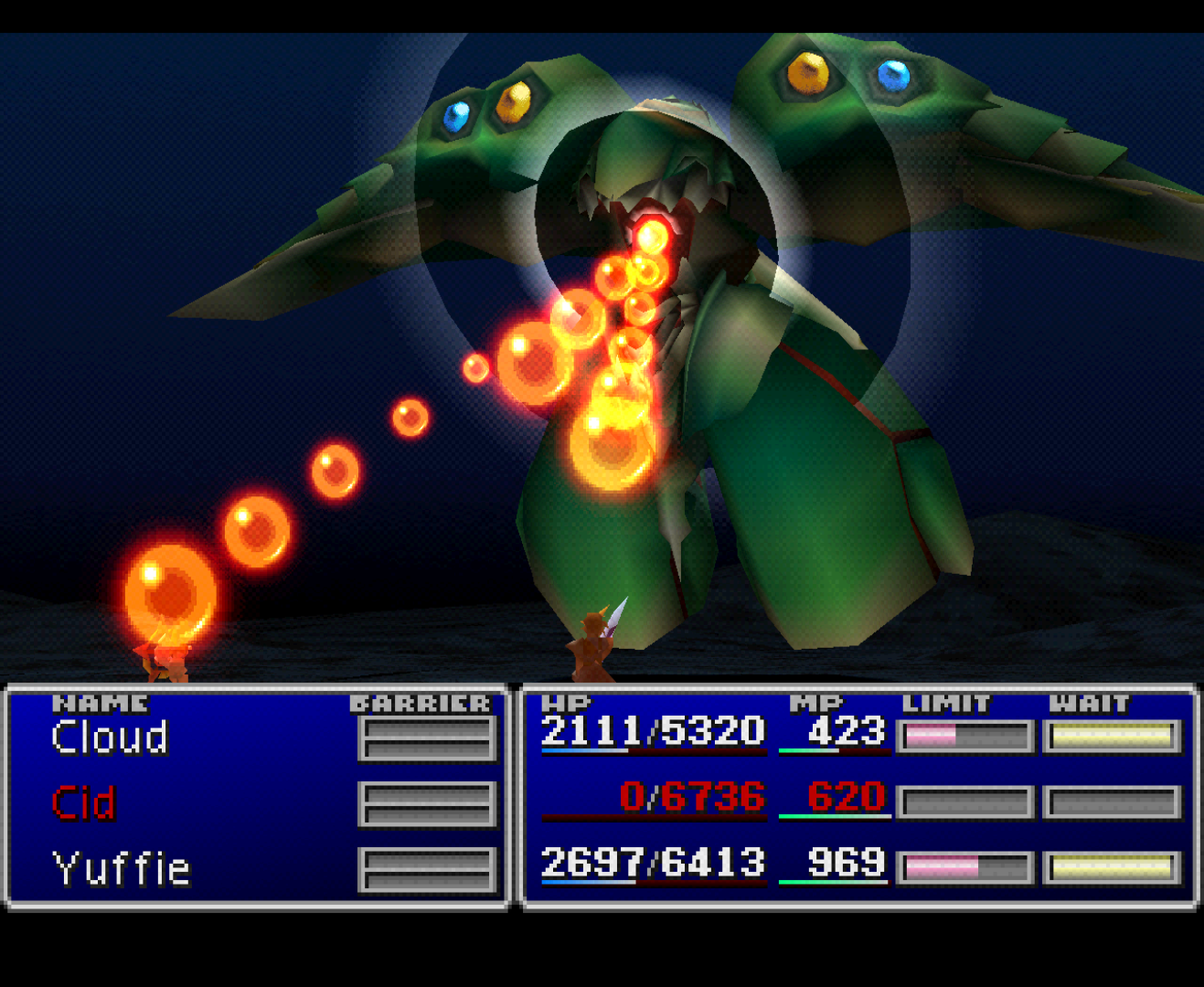
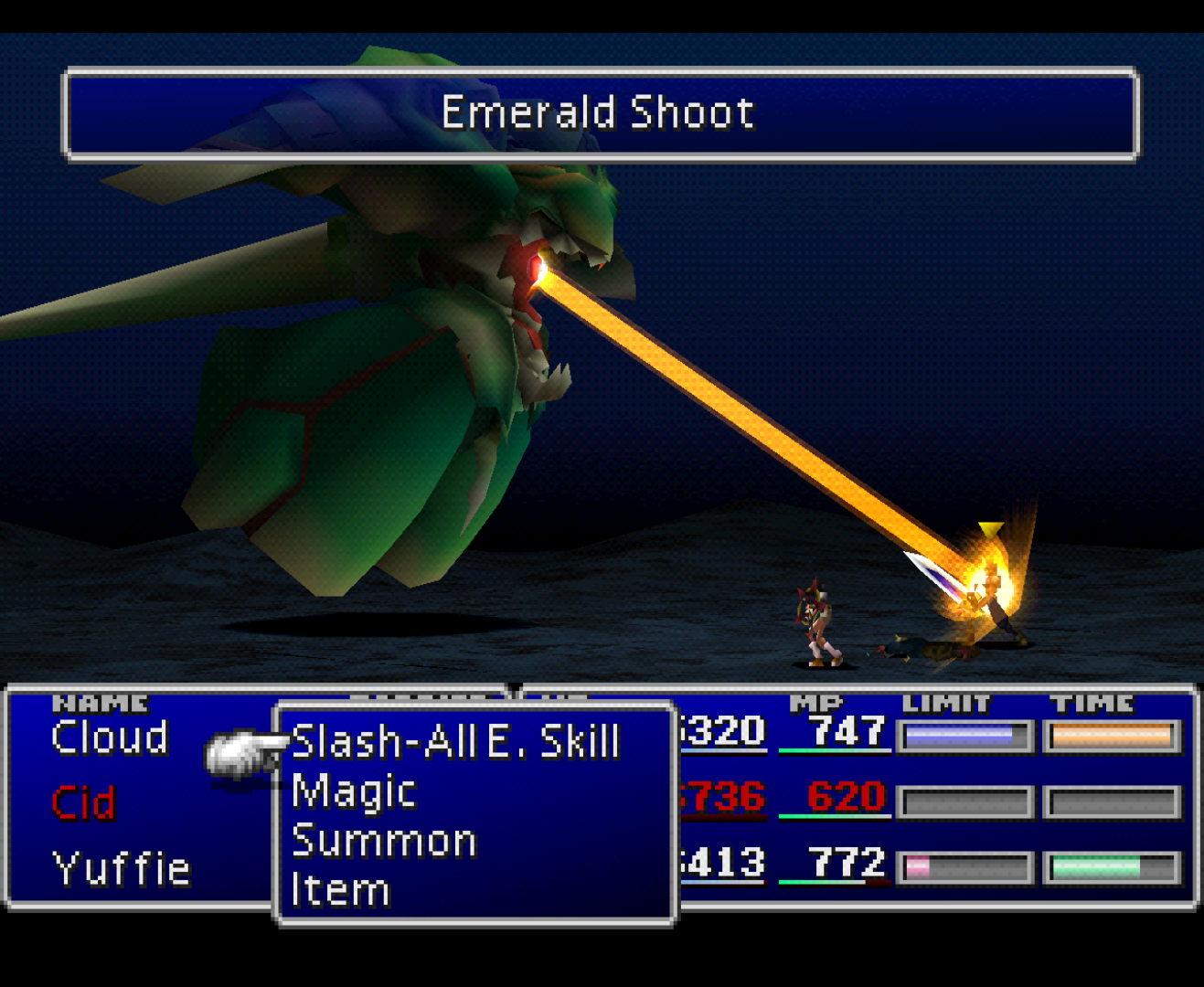
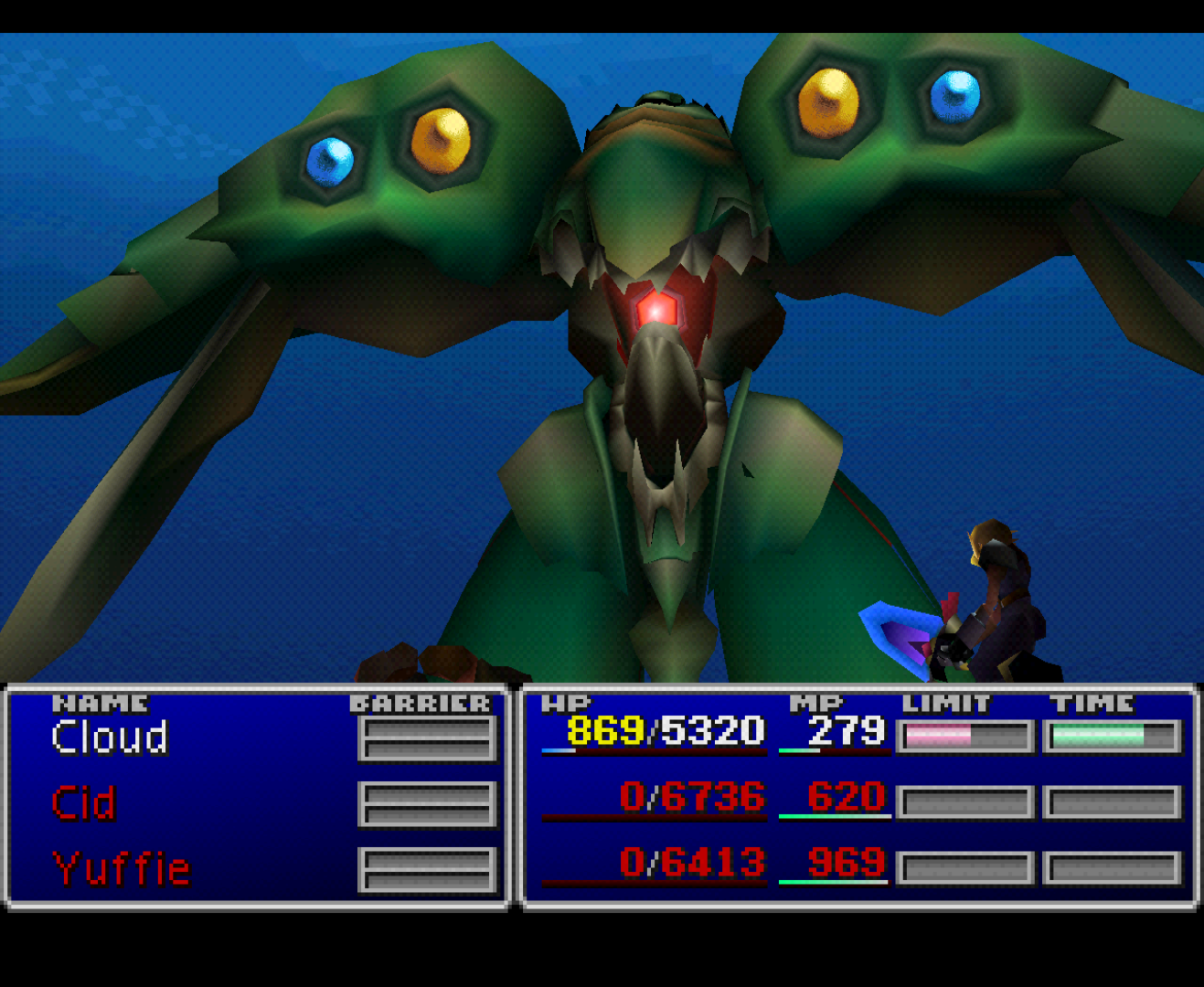
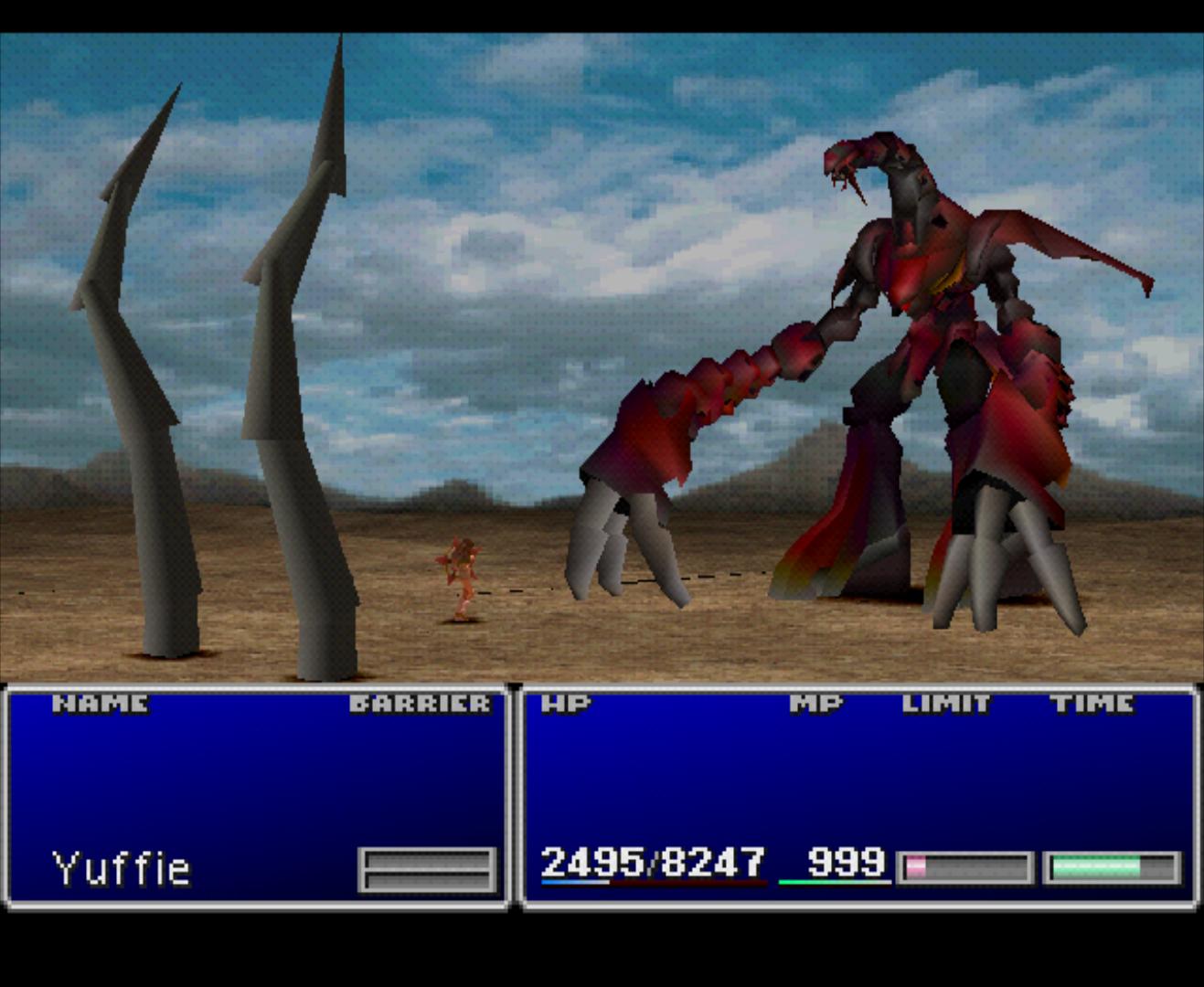
This is a collection of 20 high-quality screenshots from the Playstation JRPG Final Fantasy VII.
They were taken in RetroArch and the Beetle PSX core, with no shaders.
These are simply shots from my last playthrough that I found interesting. It’s not a comprehensive look at the game, and most pictures are either from early on or very late in the game.
Feel free to use these screenshots on your own website or in your own project. If you do, we would greatly appreciate a link back to Great Adventures Review.
AVGP [action video-game players] were observed to have superior cognitive skills, on average, compared with individuals who engage less in video game play.
The data used to reach this conclusion came from 104 studies that have been published over the last 20 years.
The types of cognitive skills tests where action game players had the biggest advantage were:
Perceptual (spot something accurately and quickly)
Top-down attentional (stick with a goal to find a target)
Spatial (such as mentally rotating objects)
Multitasking (switch between goals with less performance sacrifice)
Though it may seem intuitive that a session of playing games might “warm up” a brain, and mean better results in a test taken immediately afterwards, this study avoided looking at only short-term effects:
In line with our focus on long-term training effects (as opposed to acute physiological arousal effects), the training had to be equivalent in both experimental and control groups in terms of duration (minimum 8 hr) and number of sessions (minimum 8 days) and posttest performance measures had to be performed at least 24 hr after training.
As this research looked at many studies, there were many different methods for measuring the traits. To give an example of one, a method for measuring “top-down attention” is an object tracking test, which looks like this (try and follow the dot that starts green):
The authors looked at studies that took different experimental approaches: some observed existing players and non-players (cross-sectional study), others gave subjects action games to play and compared the results to a control group (intervention study). The positive relation between playing action games and performance in the cognitive tests was observed in both types of study
My thoughts
I was impressed with the breadth of this research, and the conscientiousness of the authors, who take pains to keep the data reliable and to avoid publication biases and outlier statistics.
There is more I would like to see studied in this area. Do videogames build resilience to failure? What skills do strategy and puzzle games improve? How does game difficulty (perceived and objective) affect the outcomes?
Naturally, I am also curious about what undesirable traits are increased by playing videogames, and where an ideal balance might lie.
What next
Some will read this, pat themselves on the back for their wise choices in gaming material, mouth “I told you so” to the world, then play another round in Dustbowl. But I don’t highlight this research so that gamers can bask in the glow of group superiority.
Rather, it makes me curious about what roles games might play in benefitting society in the future.
The typical perception today is that games, while an acceptable use of leisure time, are still basically unproductive. This research suggests to me that an hour of videogames is sometimes better than an hour without videogames.
We recognise the importance of reading and physical education in human development, and parents and schools make time for these activities. Is there room for the right games, deployed in the right way, in schools?
If that is taking things too far, instead of treating games purely as unproductive leisure, can we say that, sometimes, videogames are a form of exercise too?
My mind is open to these possibilities, though I think it will be a long time before they are considered seriously.
If you’re interested in the positive outcomes of playing games, here is a recent podcast on the subject:
People fall in love with Oddworld for different reasons. The gorgeous, cinematic vistas and character animations. The non-human characters and the bizarre world they live in. The sense of humour. The messages about environmentalism and corporate greed. The mix of real-time puzzles and tense chase scenes. A unique range of abilities including possessing your enemies and leading other characters with speech commands.
Best picks!
All the 20+ games on this list have a one or more of the above traits and are good games besides. Our top picks have several of the above traits as well as being amazing games. So if you’re an Oddworld fan, any of the following five is likely to be a game you fall in love with.
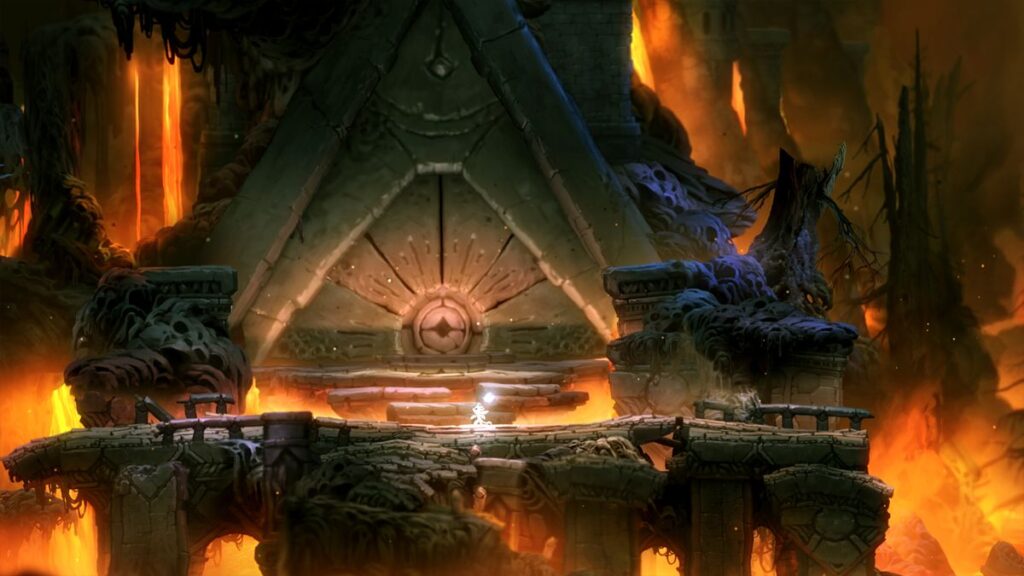
1. Ori and the Blind Forest, Ori and the Will of the Wisps
Abe’s Oddysee is packed with high-resolution natural environments and tense chase scenes. The Ori games nail these qualities too: the layers of detail in Nibel forest are unique among 2D games today, just as Abe’s Oddysee’s scenes were in 1997, and the escape sequences will have you gripping your controller as if there is a Scrab behind you.
The cat-monkey-spirit-thing Ori, like Abe, is a vulnerable character who scurries through woodlands and ancient temples to save his land. His game doesn’t have much dialogue but it does tell a good story. It can be light hearted and charming and it can be dark, errie and threatening, and that’s a combination that any Oddworld fan will appreciate.
Here’s a one minue clip that shows off some of what Ori and the Blind Forest has to offer:
2. Psychonauts, Psychonauts 2
If a psychedelic colour scheme seems like a hundred miles away from the tones of Oddworld, don’t judge it yet. The strange worlds of Psychonauts exist in the minds of the strange characters, and that level of strangeness can’t fail to tickle the fancy of an Oddworld players.
Other than all that, it’s a creatively designed platformer, has a great sense of humour, and a story that will keep you gripped.
Mind-control is a key tool in Abe’s arsenal, and it is much more deeply explored here, with the main character Raz delving into the psyches of various characters where he is threatened by figments of their anxieties, ambitions and past traumas.
Here’s an quick example from an early cutscene:
3. Another World
Here’s a game that inspired Oddworld! Both Another World and the first two Oddworld games feature challenging puzzles and tense platforming chases that require precision and timing. The games share atmospheric and otherworldly locations, like the eerie alien planet of Another World and the oppressive factory of RuptureFarms in Abe’s Oddysee.
What makes this predecessor to Oddworld even more impressive is that almost ever scene is unique. Challenges and obstacles are very rarely repeated, making the game feel timelessly cinematic. Oddworld takes you to another world, and so does Another World.
Even in this clip from very early in the game, you can see where the level designers of Oddworld were getting some of their ideas from:
4. Inside
What blows me away about Inside, something that few games have managed since Oddworld, is how it makes you feel like you’re in a fully 3D world despite having entirely 2D mechanics. In Oddworld, the camera would seamlessly disconnect from the screen and fly over Mosiac Lines or whichever location you were in, in an FMV sequence that showed off the breadth and detail of the world in which your adventure takes place. Inside also indicates depth, also by clever use of the camera, lighting and background elements. It all looks totally natural.
The gameplay of Insider revolves around puzzle solving and platforming that require creative thinking and precision, similar to Abe’s Oddysee. Both games also have a dark and oppressive atmosphere, with unsettling locations and characters that keep players engaged. Neither game is afraid of a cynical ending, either.
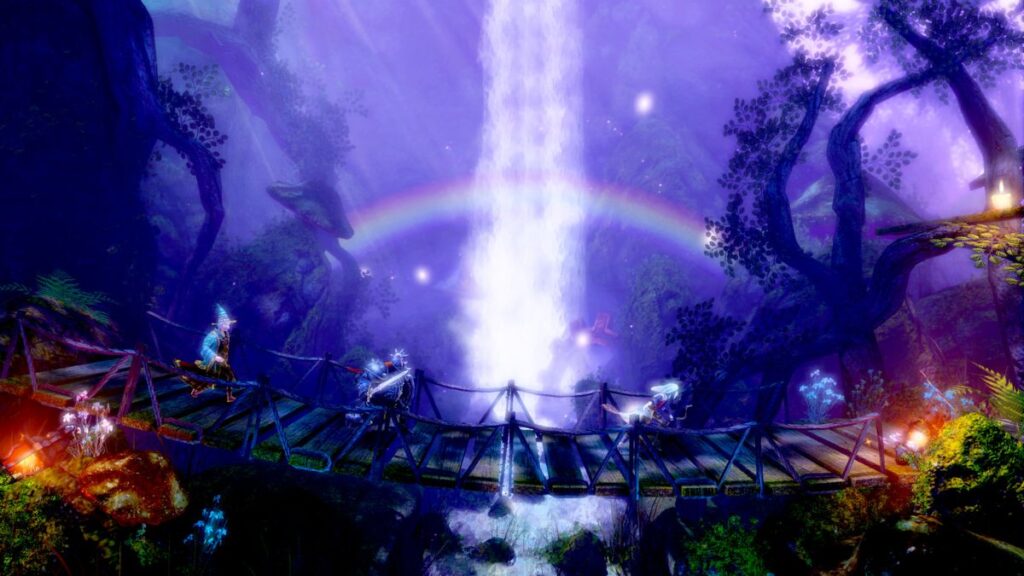
5. Trine series
There are two game franchises that do detailed 2.5 better than any other, and those are Oddworld and Trine. The latter game’s fantastical setting, with its castles, caves, and forests, creates a sense of wonder and immersion similar to Abe’s Oddysee and Exodus. The aesthetic of both games is utterly charming and that draws players in.
Both games feature challenging puzzles and platforming sections that require creativity and problem-solving skills. Trine allows players to switch between three unique characters with different abilities. It’s not quite the same as leading Mudokons to safety in Oddworld, but the party-based puzzle solving has a similar ring to it.
Even more
There are 10+ games below that we think have a good flavour of Oddworld to them. For some, this was based on their mechanics, for other on their visual design, and others on their sense of humour. In all cases, we have linked to somewhere relevant (usually the Mobygames page) where you can get an impression of what that game is like.
Classic cinematic platformers
The first two Oddworld games were part of a genre called the cinematic platformer, which most people consider to have started with Prince of Persia in 1989. The first designers of Oddworld were inspired by these titles, and the ones we have selected here
It’s not like cinematic platformers stopped being made. Here are newer examples that capture the feeling of creeping your way through an oppressive enviroments, leaving you at risk of Rupture Farms flashbacks:
Many of the early cinematic platformers were described as “single screen” meaning that the screen did not move with your character, but was static until the player reached the end of it, causing it to scroll. In other worlds, the world was make up of a sequence of “single screens”. Here are some more extremely well designed puzzling adventures in this style:
Point and click adventure games can rival Oddworld in well developed worlds, empathetic characters and comedic writing. Not all of them are as strange and fantastical as the following, though:
These ones might seem to have only tenuous similarities to Oddworld. Nonetheless, they are great games and they might be the new experience that you are looking for. After all, Oddworld was nothing if not novel!
This fondly remembered series started with Jade Cocoon: Story of the Tamamayu on the PS1 in 1991, which has one sequel.
The Japanese box art for the first Jade Cocoon game
This eye-catching box art shows off the first thing that made people fall in love with these games, which is:
The art of Katsuya Kondō, a character designer from Studio Ghibli
Considered a top animator in the Japanese film industry, helping bring classics such as Kiki’s Delivery Service to life, the Jade Cocoon duology are the only games Kondo has lent his talents to.
The cover image of Katsuya Kondo’s Jade Cocoon artbook
In addition to the artwork, the first Jade Cocoon is loved by fans for:
Monster fusion based on dynamic merging of monster polygons and textures
The first monster selected to be merged contributes its shape, and the second monster contributes its texture, and additional modifiers also affect the final monster’s appearance.
The monsters that you fight with are therefore not ones that have been entirely hand-crafted by the developers, but ones that have been generated uniquely according to your choices.
To this day, this system of monster generation is something no popular monster raising game has attempted.
A rich fantasy world and an emotional story
Pokemon and Shin Megami Tensei games were set in the real world, but Jade Cocoon combines monster raising with a more traditional JRPG narrative and aesthetic.
This new combination was a stated goal of the development team:
We had two goals. One was to create an immersive story world, and the other was to provide compelling monster-raising gameplay. In this way, the game would be both stylistically and technically unlike anything else on the market.
Gaku Tamura or Shinya Kozaki, director and scriptwriter respectively (Interview)
The characters of Jade Cocoon start the game at the cusp of adulthood, and face life changes including marriage and undertaking dangerous work for their town. The people they meet are grappling with their own situations and pasts.
The story concerns the events of a single town and the surrounding woodlands, the perils they face and the suffering of the characters for the sake of their fellow townspeople.
Clashes between the town and forest occur throughout the story, sometimes with tragic consequences.
If we pursue the theme of people and nature, we have no choice but to be conscious of “Princess Mononoke.” You can’t help but be affected.
Exploring the forests of Jade Cocoon: Story of the Tamamayu
In keeping with the theme of humans coexisting with nature, forests are the dungeons of these games. They are rich with natural variety and detail.
These forests, where the majority of gameplay takes place, are where the player meets the monsters, called “divine beasts”, which can be captured in cocoons after they are weakened.
The monsters grow in size as they level up. They have an elemental attribute, be of the earth, fire, water or air elements (or a combination).
Here are four monsters, one for each element:
The atmosphere the forests is enhanced by the music of Kimitaka Matsumae, who says:
The world of Jade Cocoon is a wonderland like Asia and Africa, so I tried using Asian and African techno.”
Jade Cocoon 2 was released in 2001. In Japan, it had a subtitle that can be translated as “Insect of Destruction” but lacked a subtitle for international release.
Both Jade Cocoon game have their own strenths and weaknesses, though they also have a lot of shared themes.
In general, these are some of the common views on the sequel compared to the first game:
Less focus on story, more lighthearted, questionable voice acting quality
Lacking dynamic monster fusion
Adds a more interesting battle system where three monsters at a time take action, and in total a ring of up to eight monsters are brought into battle in total
Both games have an endless endgame dungeon called the Eternal Corridor where the player can continue to raise and fight their monsters to their heart’s content:
Series at a glance
Fandom
Even 30 years later, Jade Cocoon has remained in in the hearts of fans as a unique experience that other monster raising games have been unable to repeat. You can find those fans online in the following communities:
Every film wants to be a cinematic universe, and every game wants to be Dark Souls — according to some.
The cynic inside us already has an answer to why: the games of From Software have a large, paying fanbase, and other studios want a slice of that pie.
A manager who sits at least three floors away from the creative team (if not in a different office entirely) measures the correlation between different Steam tags and estimated sales, and concludes that if they can slap the “soulslike” label on the company’s next game, potential earnings increase by 74%.
A PowerPoint presentation may have been used to convey the message.
If the omnipresence of romantic teenage vampires was the telltale sign that the book market was riding on the popularity of Twilight, there are a few tropes in which we can see a dedication to the From Software formula in the videogame industry:
An intimate, close-up, over-the-shoulder third-person perspective
Weighty combat actions with a long wind-up, long recovery
Bonfires that save progress but reset enemies
A stamina bar that is drained by all actions, including dodges and basic attacks
It’s hard to deny: these things are common in action games where they were not before.
In God of War
God of War III vs God of War (2018)
BeforeAfter
In Darksiders
Darksiders II vs Darksiders III
BeforeAfter
In games by Team Ninja
Ninja Gaiden vs Nioh
BeforeAfter
Some studios seem to have built their entire business model on the trend
Lords of the Fallen by Deck13, also the developer of The Surge, another Soulslike.
New action games love to use Hidetaka Miyazaki’s masterpieces as a blueprint
Upcoming Black Myth: Wukong and Lies of P.
However, to me, this does not represent creative laziness, but creative passion. The altar that Miyazaki built is revered by creators as much as consumers. Developers have played Dark Souls, been inspired by naturalistic level design, eye-catching art direction, high level of tension and rewarding combat encounters.
If you’re not a fan of Souls, this might not sound so great. There are many elements of Souls that are like marmite: you either love them or hate them:
Backtracking
Unexplained mechanics
Save points that work like bonfires
Runbacks before boss encounters
No difficulty settings
Stamina management
But it’s not like every third-person action game is moving in this direction
Astral Chain
My view is that the third-person melee action genre, a genre that I love, has been reinvigorated in recent years, and Dark Souls had a part to play in that.
Yes, there are more games out there that look like Dark Souls, but also more games in this genre in general. There might even be more diversity in the genre than ever before.
As a closing word, remember that trends come and go. I fully expect more studios to drift away from the Souls style within a few years.
…though, as these cycles go I, expect it will come back again. Love it or hate it, Dark Souls has cast a spell on the industry, and to get rid of it entirely is a challenge that goes far beyond Ornstein or Smough.
This is a collection of 75 high-quality (and hopefully interesting) screenshots from the Playstation game Xenogears.
They were taken in RetroArch with the crt-easymode shader applied.
This is not a comprehensive tour of Xenogears, but it does feature a variety of areas including some from late in the game. To find out what makes this game worth playing, read my Xenogears review.
Feel free to use these screenshots on your own website or in your own project. If you do, we would greatly appreciate a link back to Great Adventures Review.